Closing your books at the end of the financial year doesn’t have to feel overwhelming. With the right year end accounts checklist, you can stay compliant, avoid costly errors, and gain a clear picture of your business performance. Whether you’re a small business owner or an accountant, following a structured approach ensures nothing slips through the cracks.
This guide walks you through a useful year-end accounting checklist that UK companies can use. It includes everything from financial statements to reconciliations.
Key Takeaways
- A year-end accounts checklist ensures accuracy, compliance, and financial clarity
- Key steps include reconciliation, adjustments, and financial statement preparation
- Small businesses can simplify the process with structured workflows or outsourcing
- Proper documentation is critical for a smooth year-end closing
What Is a Year-End Accounts Checklist?
A year-end accounts checklist is a structured list of tasks businesses and accountants follow to prepare accurate financial statements at the end of a financial year. It ensures that all transactions are recorded correctly, accounts are reconciled, and statutory requirements are met.
In the UK, this checklist is especially important for compliance with HMRC and Companies House requirements. It also forms the foundation for tax filings and strategic decision-making.
Why the Year-End Accounting Process Matters
When you do your year-end accounting, you’re not just following the rules; it’s also a good time to check on your business’s finances. It helps you figure out how profitable your business is, where it’s not working as well as it could, and how to plan for the next fiscal year.
A well-prepared financial year end checklist ensures:
- Accurate tax calculations
- Better cash flow visibility
- Improved financial planning
- Reduced risk of audits or penalties
Complete Year-End Accounts Checklist UK
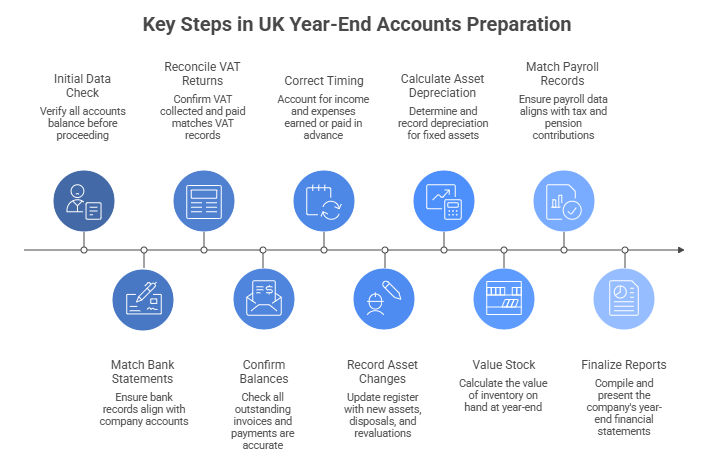
Here’s a comprehensive accounting year end checklist to guide your process:
1. Review Trial Balance
Start with a thorough trial balance review to ensure all ledger accounts are accurate and balanced. Look for discrepancies, duplicate entries, or missing transactions.
2. Bank Reconciliation
Perform bank reconciliation to match your internal records with bank statements. This helps identify errors, unrecorded transactions, or fraudulent activity.
3. VAT Reconciliation
Ensure all VAT transactions are correctly recorded and aligned with your returns. If you’re unsure about compliance, understanding What Is VAT Registration can help clarify obligations.
4. Verify Accounts Receivable and Payable
Check outstanding invoices and bills. Write off bad debts if necessary and confirm creditor balances.
5. Adjust Accruals and Prepayments
Account for accruals and prepayments to ensure income and expenses are recorded in the correct accounting period.
6. Update Fixed Assets Register
Review your fixed assets register, ensuring all assets are recorded, disposed items are removed, and additions are included.
7. Depreciation Calculation
Perform accurate depreciation calculation for all assets to reflect their current value.
8. Inventory Valuation
Conduct stock checks and ensure inventory is valued correctly using appropriate accounting methods.
9. Payroll Reconciliation
Ensure payroll records match HMRC submissions and all employee-related liabilities are accounted for.
10. Prepare Financial Statements
This is the final and most critical step in year end accounts preparation:
- Profit and loss statement to assess performance
- Balance sheet preparation to evaluate financial position
These form the core of your financial statements checklist.
Year End Accounts Checklist for Small Business UK
For small businesses, the process may be simpler but still requires attention to detail. A year end accounts checklist for small business UK typically includes:
- Reviewing income and expenses
- Ensuring all invoices are recorded
- Reconciling bank and VAT accounts
- Preparing basic financial statements
Many small businesses choose to outsource Year end Account Services to reduce workload and ensure accuracy.
How to Prepare Year End Accounts Step by Step UK
If you’re wondering how to prepare year end accounts step by step UK, here’s a simplified flow:
- Gather all financial records
- Reconcile bank, VAT, and payroll
- Adjust accruals and depreciation
- Review trial balance
- Prepare financial statements
- Submit reports to HMRC and Companies House
This structured year end accounting checklist for limited company ensures compliance and clarity.
What Is Included in Year End Accounts UK?
Understanding what is included in year end accounts UK is essential. Typically, it includes:
- Profit and loss account
- Balance sheet
- Notes to the accounts
- Director’s report (for limited companies)
These documents provide a complete picture of your business’s financial performance and position.
Documents Required for Year End Accounts
To complete your year end accounting checklist UK, gather the following:
- Bank statements
- Sales and purchase invoices
- Payroll records
- VAT returns
- Asset purchase details
- Loan and financing documents
Having these ready ensures a smooth year end accounts preparation process.
Managing year-end accounts can be complex, especially as your business grows. That’s where Stellarwiz comes in. With expert-driven financial solutions, Stellarwiz helps businesses streamline their year end accounting process, ensure compliance, and improve financial clarity.
From reconciliations to final reporting, leveraging professional support allows you to focus on growth instead of paperwork.
Conclusion
A well-structured year end accounts checklist is essential for closing your financial year with accuracy and confidence. From reconciling accounts and reviewing your trial balance to preparing financial statements, each step plays a critical role in ensuring compliance and giving you a clear view of your business performance.
For UK businesses, staying aligned with HMRC requirements while maintaining clean, organized records can make a significant difference in avoiding errors and penalties. Whether you manage the process in-house or choose to outsource Year end Account Services, having a reliable system in place simplifies the entire year end accounting process.
Ultimately, year-end accounts aren’t just for compliance; they’re also a chance to look at growth, find gaps, and make better plans for the coming year.
Frequently Asked Questions
1. What is a year end accounts checklist?
A year end accounts checklist is a list of accounting tasks that ensures all financial records are accurate and complete before closing the financial year.
2. What should be included in year end accounts?
Year-end accounts typically include a profit and loss statement, balance sheet, and supporting notes, forming a complete financial statements checklist.
3. When should year end accounts be prepared in the UK?
UK businesses usually prepare year-end accounts after their financial year ends and must file them with Companies House within 9 months.
4. What documents are required for year end accounts?
Essential documents include bank statements, invoices, payroll records, VAT returns, and asset details needed for accurate year end accounts preparation.