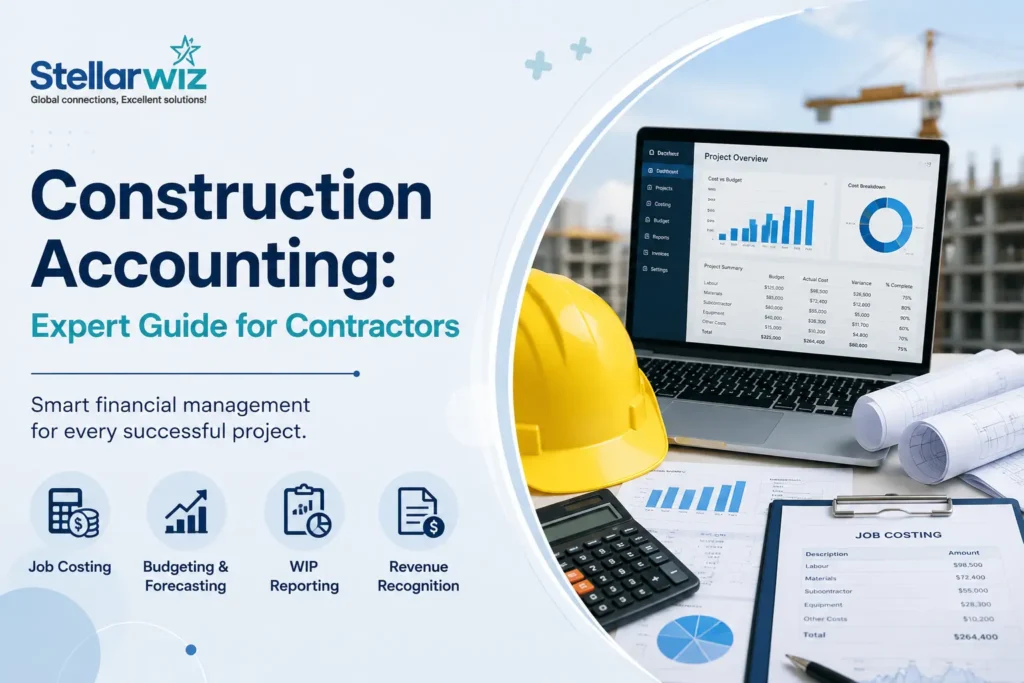
Managing finances in the construction industry is far more complex than handling the accounts of a typical business. Construction companies often manage multiple projects simultaneously, each with its own budget, timeline, workforce, and material costs. Without a structured financial management system, projects can quickly suffer from budget overruns, cash flow issues, and reduced profitability.
This is where construction accounting plays a crucial role. Unlike traditional accounting, it is specifically designed to manage project-based finances, helping contractors accurately track costs, recognise revenue, monitor project performance, and maintain financial control throughout every stage of construction.
Whether you’re an independent contractor, builder, or construction company, understanding the fundamentals of construction accounting can help you improve profitability, streamline operations, and make informed business decisions.
Key Highlights
- Construction accounting is specifically designed for contractors and construction businesses.
- It focuses on project-based financial management rather than overall business accounting.
- Job costing helps track labour, materials, equipment, and subcontractor expenses for every project.
- Revenue recognition ensures accurate financial reporting for long-term contracts.
- Work-in-Progress (WIP) reporting provides real-time visibility into project performance.
- Proper accounting improves cash flow management, budgeting, and profitability.
- Many contractors choose outsourced accounting services to improve efficiency, reduce costs, and ensure compliance.
- Read What Is Outsourced Accounting to understand how outsourcing accounting functions can help construction businesses focus more on project delivery.
What Is Construction Accounting?
Construction accounting is a specialised accounting method developed specifically for contractors, builders, and construction companies. Rather than simply recording income and expenses, it focuses on tracking the financial performance of each individual project.
Construction projects often span several months – or even years—and involve multiple cost categories, including labour, subcontractors, materials, equipment, transportation, permits, and overhead expenses. Construction accounting helps organise these costs so businesses can accurately monitor project profitability.
Key functions of construction accounting include:
- Job costing
- Project budgeting
- Progress billing
- Revenue recognition
- Work-in-Progress (WIP) reporting
- Payroll management
- Equipment cost allocation
- Financial forecasting
By maintaining detailed project-level financial records, contractors gain greater visibility into business performance and can make proactive decisions to improve profitability.
Construction Accounting vs Traditional Accounting
Although both follow standard accounting principles, construction accounting is significantly different from traditional accounting because it revolves around individual projects rather than day-to-day business transactions.
| Traditional Accounting | Construction Accounting |
| Focuses on overall business finances | Focuses on individual projects |
| Predictable revenue and expenses | Variable project costs |
| Standard invoicing | Progress billing and retainage |
| General expense tracking | Detailed job costing |
| Simple revenue recognition | Long-term revenue recognition methods |
Construction businesses frequently manage multiple active projects across different locations. This requires accountants to allocate labour, equipment, transportation, subcontractor payments, and overheads accurately to each project, ensuring reliable financial reporting and profitability analysis.
Key Principles of Construction Accounting
1. Job Costing
Job costing is the backbone of construction accounting. Every expense associated with a project is assigned to a specific job, allowing contractors to accurately measure project profitability.
Typical job costs include:
- Labour wages
- Building materials
- Equipment hire
- Transportation expenses
- Subcontractor payments
- Site overheads
Accurate job costing helps contractors identify budget overruns early, improve project estimates, and increase profitability on future contracts.
2. Revenue Recognition
Construction projects rarely finish within a single accounting period, making revenue recognition more complex than in most industries.
The two commonly used methods are:
Completed Contract Method
Revenue and profit are recognised only after the entire project has been completed. This method is typically suitable for shorter projects where the outcome can be measured reliably upon completion.
Percentage of Completion Method
Revenue is recognised progressively based on the percentage of work completed. This approach provides a more accurate picture of financial performance throughout long-term projects and supports better financial planning.
3. Work-in-Progress (WIP) Reporting
A Work-in-Progress (WIP) report tracks the financial status of ongoing construction projects by comparing:
- Costs incurred
- Revenue recognised
- Amount billed
- Remaining project budget
- Estimated profit
WIP reporting enables contractors to identify underbilling, overbilling, and potential cost overruns before they affect project profitability. It also improves forecasting and supports better financial decision-making.
4. Cash Flow Management
Cash flow is one of the biggest challenges in the construction industry. Contractors often need to pay employees, suppliers, and subcontractors long before receiving full payment from clients.
Strong construction accounting practices help businesses:
- Monitor incoming and outgoing cash
- Forecast future expenses
- Track outstanding invoices
- Manage payment schedules
- Maintain sufficient working capital
Effective cash flow management ensures projects continue without financial disruptions and reduces reliance on external financing.
Common Challenges in Construction Accounting
Construction companies face several unique financial challenges that require specialised accounting expertise, including:
- Managing multiple projects simultaneously
- Tracking fluctuating labour and material costs
- Controlling project budgets
- Handling subcontractor payments
- Managing payroll across different job sites
- Revenue recognition for long-term contracts
- Tax compliance and financial reporting
- Monitoring project profitability in real time
Without accurate accounting systems, these challenges can lead to costly errors, cash flow shortages, and reduced business profitability.
Why Contractors Choose Outsourced Accounting Services
As construction businesses grow, managing finances internally becomes increasingly time-consuming. Many contractors are now turning to outsourced accounting services to simplify financial management while gaining access to experienced accounting professionals.
Some of the key benefits include:
- Reduced operational and staffing costs
- Accurate bookkeeping and financial reporting
- Professional job costing and project tracking
- Payroll management
- VAT and tax compliance
- Improved cash flow monitoring
- Better financial insights for decision-making
- Scalable support as projects and business demands grow
Outsourcing accounting allows contractors to spend more time managing projects and clients while experienced professionals handle the financial side of the business.
Best Practices for Effective Construction Accounting
To maintain financial control and improve profitability, construction companies should follow these best practices:
- Track every project separately using detailed job costing.
- Review Work-in-Progress (WIP) reports regularly.
- Monitor cash flow and project budgets consistently.
- Use cloud-based accounting software for real-time financial visibility.
- Reconcile accounts and invoices frequently.
- Keep accurate records of subcontractor payments and material costs.
- Stay updated with tax regulations and reporting requirements.
- Consider outsourced accounting services to improve efficiency and reduce administrative workload.
Conclusion
Effective construction accounting is more than just recording financial transactions – it provides contractors with the insights needed to control project costs, improve cash flow, and maximise profitability. By implementing accurate job costing, proper revenue recognition, and regular Work-in-Progress (WIP) reporting, construction businesses can make informed financial decisions, minimise risks, and keep projects on track.
As construction projects become more complex, many businesses are turning to outsourced accounting services to streamline financial management, improve reporting accuracy, and reduce administrative burdens. If you’re considering outsourcing, our guide on What Is Outsourced Accounting explains how professional accounting support can help construction companies operate more efficiently.
At Stellarwiz, we provide reliable outsourced accounting services tailored to the unique needs of contractors and construction businesses across the UK, USA, Canada, Australia, New Zealand, and Europe. Whether you need support with bookkeeping, job costing, payroll, or financial reporting, our experienced accounting professionals help you stay compliant, improve profitability, and focus on delivering successful construction projects with confidence.
Frequently Asked Questions
1. What is construction accounting?
Construction accounting is a specialised accounting method that helps contractors manage project-specific finances, including job costing, revenue recognition, Work-in-Progress (WIP) reporting, payroll, and project profitability.
2. Why is construction accounting different from traditional accounting?
Unlike traditional accounting, construction accounting focuses on individual projects, long-term contracts, fluctuating project costs, progress billing, and detailed job costing.
3. What is job costing in construction accounting?
Job costing is the process of tracking all expenses related to a specific construction project, including labour, materials, equipment, subcontractors, and overhead costs, to determine project profitability.
4. Why is WIP reporting important?
A Work-in-Progress (WIP) report helps contractors monitor project performance, compare costs against revenue, identify overbilling or underbilling, and improve financial forecasting.
5. Why should construction companies use outsourced accounting services?
Outsourced accounting services provide access to experienced accounting professionals who can manage bookkeeping, financial reporting, payroll, tax compliance, and project accounting, allowing contractors to focus on delivering successful construction projects.