Rising compliance requirements, a staffing shortage, and a growing administrative load are squeezing margins in UK accounting firms as clients demand faster turnaround. 92% of accountants say they spend too much time on admin, and research from Dext found that 40% of UK accountants spend over half of their working day on manual tasks. This is the backdrop against which accounting practice management software UK has become less of a nice-to-have and more of a survival tool.
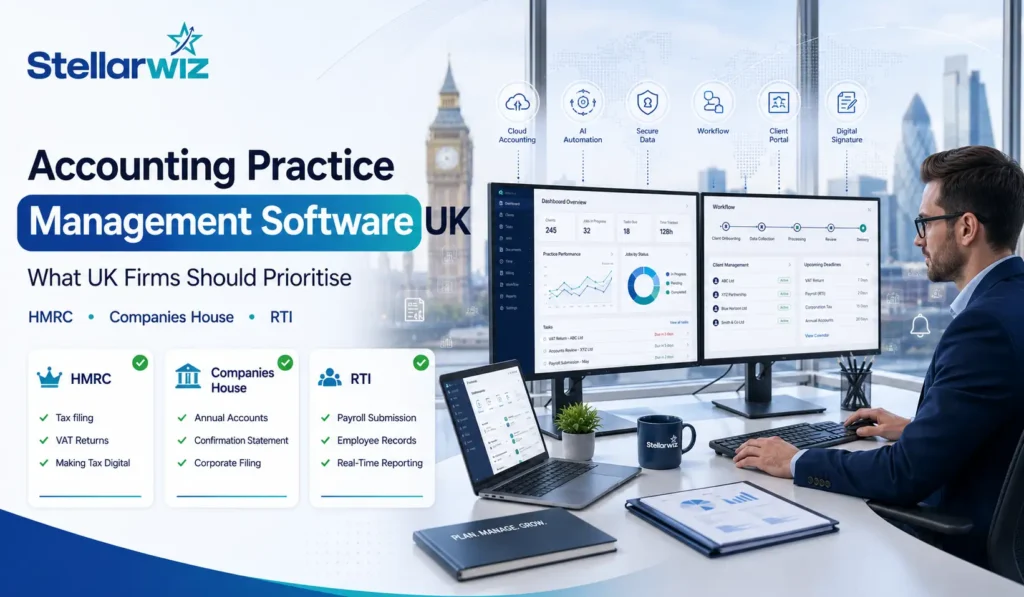
Running an accounting practice in the UK today means juggling far more than ledgers and spreadsheets. Between HMRC deadlines, Companies House filings, and payroll reporting obligations, firms need systems that keep everything organised, accurate, and on time. This is where accounting practice management software UK comes into the picture. It helps firms move away from manual tracking and towards a structured, automated way of managing client work.
If you’re evaluating options for your practice, it helps to first understand what this software actually does, why UK-specific compliance features matter so much, and what to prioritise before you commit to a platform.
Key Takeaways
- UK businesses need software that is specifically designed to meet the needs of HMRC, Companies House, and RTI, not just any old project management tool.
- Making Tax Digital (MTD) compliance is now required for VAT and will soon be required for income tax reporting.
- Direct or semi-automated Companies House filing saves significant admin time for firms managing multiple limited company clients.
- Payroll reporting under RTI must be done on or before every payday. Firms are at risk of not following the rules if their software doesn’t properly support RTI.
- In addition to compliance, you should prioritise tracking deadlines, client portals, document management, workflow automation, and reporting dashboards.
- The right platform should scale with the firm, integrate with existing tools, and be backed by UK-based support.
- Software is only half of the solution. What really makes things work better is combining the right tools with the right delivery support, whether it’s in-house or outside.
- According to industry surveys, UK accountants lose over a third of their working day to paperwork that needs to be done by hand. This means that automation is not only convenient, but also a direct way to make money.
What Is Accounting Practice Management Software?
All in all, this kind of software is made to help accounting firms in the UK handle their daily tasks, such as keeping track of clients, tasks, deadlines, documents, and communication, all from one place. Instead of relying on separate spreadsheets, email threads, and reminder apps, a firm can centralise everything into a single workflow.
For firms operating in the UK, though, generic project management tools aren’t enough. What’s needed is practice management software for accountants UK that’s purpose-built around the regulatory framework accountants actually operate under and not a repurposed tool borrowed from another industry. This matters whether you’re running everything in-house or working with an outsource accounting firm to manage part of the workload
Why UK-Specific Compliance Features Matter?
This is where many firms go wrong when choosing software: they pick a tool based on general features like task lists or invoicing, without checking whether it actually supports the compliance requirements unique to the UK.
Also Read: Top 10 Outsourced Accounting Companies in the UK (2026 Guide)
HMRC and Making Tax Digital
Any serious accounting software for UK accountants needs to align with HMRC’s Making Tax Digital (MTD) requirements. This is no longer a choice; VAT returns and, soon enough, income tax returns must be sent digitally through systems that work with MTD. A platform that isn’t built for this will eventually create more work, not less, as firms scramble to bridge data manually.
The scale of this shift is significant. HMRC estimates that around 42% of the UK’s 7 million taxpayers with self-employment or property income will need to comply with MTD for Income Tax between 2026 and 2028, and HMRC’s own tax gap report projects that MTD for VAT alone will help recover more than £4 billion. Firms that put off adapting their systems risk being caught out as these deadlines take full effect.
Firms should specifically look for HMRC-compliant accounting software that automates VAT submissions, tracks digital record-keeping requirements, and reduces the risk of penalties from late or incorrect filings.
Companies House Filing
Most firms in the UK do more for their clients than just tax returns. They also file statutory documents like annual accounts, confirmation statements, and company changes. Software with direct or semi-automated Companies House filing capability saves significant admin time and reduces the back-and-forth of manual submissions. This is especially valuable for firms managing dozens (or hundreds) of limited company clients at once. Firms that would rather hand this off entirely often turn to Company Secretarial Services to keep statutory filings on track without adding to internal workload.
RTI Payroll Reporting
For firms offering payroll services, Real Time Information (RTI) compliance is non-negotiable. RTI payroll software UK ensures that employee payment and deduction data is reported to HMRC on or before each payday, exactly as required. Software that doesn’t handle RTI properly puts both the firm and its clients at risk of compliance issues. Firms without the internal capacity to manage this in-house can also lean on Outsourced Accounting Services to keep payroll reporting compliant without hiring additional staff.
Features UK Firms Should Prioritise
Once compliance is covered, the next question is workflow efficiency.
Expert view: Practice management software is most effective when firms first standardise their workflows. Automating an inefficient process simply lets mistakes happen faster.
Here’s what tends to separate a genuinely useful platform from a basic one:
Deadline Tracking & Reminders
Good platforms keep track of all of your regular tasks, like filing your VAT returns, RTI payrolls, Companies House confirmation statements, and your accounts, on a single calendar. If you forget to do something, the system will automatically alert a manager or partner. This removes the reliance on any one person remembering a date, which matters most during busy seasons when staff are stretched across dozens of clients at once.
Client Portals
Rather than relying on email attachments, client portals give clients secure, real-time access to their documents and reports. In practice, this means secure document exchange instead of unencrypted email threads, electronic approvals so sign-off happens with a click instead of a chased-up reply, and a noticeable drop in email traffic as routine back-and-forth moves into the portal itself.
Document Management
With access controls that meet UK data protection standards, centralised, cloud-based document storage keeps client records safe, organised, and simple to find. This also creates a clear audit trail, which is useful both for internal quality checks and if HMRC or a regulator ever asks how records were handled.
Workflow Automation
Templated job pipelines move work automatically from preparer to reviewer to partner sign-off, cutting down on the redundant manual chasing that eats into billable time. As the expert above said, there is one catch: automation only works if the process underneath is consistent. If the workflow is already disorganised, automating it will only make things worse.
Reporting Dashboards
Partners and managers can see at any time what tasks are still open, overdue, or finished for each client, each staff member, or the whole practice. This is also where firms typically track work-in-progress and staff utilisation, feeding directly into Management Accounts Services if the firm wants that data turned into a regular management reporting pack rather than just a live dashboard.
A well-built cloud practice management software UK solution brings all of this together, allowing teams to work from anywhere while keeping client data secure and synced in real time.
Accounting Software vs Practice Management Software
These two categories get confused often, and most firms of any size eventually need both. Accounting software handles the financial transactions themselves; practice management software handles the work of running the practice around those transactions.
| Accounting Software | Practice Management Software |
| Bookkeeping | Workflow management |
| Payroll | Deadline tracking |
| VAT returns | Client communication |
| Bank feeds | Team collaboration |
| Financial reporting | Job management |
How to Choose the Right Software for Your Practice
Each company has its own “best” platform, which is based on its size, service mix, and client base. That said, a few practical questions can guide the decision:
- Does it genuinely support MTD, RTI, and Companies House requirements, or does it require workarounds?
- Can it scale as the practice grows, or will you outgrow it within a year or two?
- Does it integrate with the accounting and payroll tools you already use?
- Is client data protected with proper access controls and encryption?
- Does the vendor offer UK-based support that understands local regulatory nuances?
Firms that take the time to answer these questions before signing up tend to avoid the costly disruption of switching systems later.
Common Mistakes When Choosing Practice Management Software
Even experienced firms fall into predictable traps when selecting a platform. The most common ones are worth naming directly:
- Choosing price over functionality: The cheapest option is rarely the cheapest once staff time lost to workarounds is factored in.
- Ignoring HMRC compatibility: A platform that can’t keep pace with MTD or RTI changes becomes a liability, not a time-saver.
- Poor staff training: Even the right software underperforms if the team reverts to old habits and manual workarounds.
- No workflow automation: Buying software but keeping manual handoffs between staff wastes most of the potential time savings.
- No scalability: A platform that suits five clients today can become a bottleneck at fifty; firms should ask how the vendor supports growth before signing.
- Weak integration options: A platform that doesn’t talk to Xero, QuickBooks, Sage, or IRIS just creates a second silo of data entry.
As a rule, the firms that get the most value from practice management software are the ones that treat the purchase as a workflow decision first and a technology decision second.
Where Stellarwiz Fits In
Software controls the flow of work between staff and clients, including deadlines, approvals, and the movement of documents. But someone still has to do the bookkeeping, payroll, and VAT work that moves through that workflow. That’s where outsourced teams complete the picture: the software creates the structure, and the delivery team creates the capacity to actually get the work done. Together, they improve both productivity and how much work a firm can take on without adding headcount.
Stellarwiz does work for accounting firms and businesses in the UK. They do Outsourced Bookkeeping Services, payroll, VAT returns, and compliance work using Xero, QuickBooks, Sage, and IRIS, which are all platforms that firms already use. Many firms also bring in outside help around Year-End Accounts, when internal capacity is stretched thinnest. When businesses are trying to decide whether to buy software or hire outside help, it’s not always an either/or choice. The right software paired with the right delivery team is what really makes the difference in efficiency.
Wrap Up
Choosing the right accounting software UK platform ultimately comes down to five things: staying compliant with HMRC, MTD, RTI, and Companies House; running day-to-day work efficiently; scaling without adding unnecessary headcount; keeping clients well served through faster turnaround and clearer communication; and building a practice that can grow rather than one that’s constantly firefighting admin. Get those right, and accounting practice management software UK stops being an overhead and becomes a genuine growth enabler for the practice. Stellarwiz can help you decide whether to solve this problem with software only or software backed by a delivery team. Talk to us about how to pair the right platform with the right outsourced support for your company.
Frequently Asked Questions
1. What is accounting practice management software?
It’s software designed to help accounting firms manage client work, deadlines, documents, and communication from a single centralized system, rather than relying on spreadsheets and separate tools.
2. Why do UK accounting firms need practice management software?
UK businesses have to follow certain rules, like filing with HMRC, Making Tax Digital, Companies House, and RTI for payroll, which standard project management tools aren’t built to handle.
3. How does practice management software help with HMRC compliance?
It automates VAT submissions under Making Tax Digital, tracks digital record-keeping requirements, and flags upcoming deadlines to reduce the risk of late or incorrect filings.
4. Does accounting software integrate with Companies House?
Many modern platforms offer direct or semi-automated filing capability for confirmation statements and annual accounts, reducing manual submission work.
5. What is RTI and why is it important?
RTI (Real Time Information) requires employers to report payroll data to HMRC on or before each payday. Software with built-in RTI support ensures firms stay compliant without manual reporting errors.
6. Can small accounting firms benefit from practice management software?
Yes. Even smaller practices benefit from automated deadline tracking, client portals, and centralised document management, which frees up time otherwise spent on manual admin.