Millions of UK residents must file Self Assessment tax returns, including landlords, company directors, freelancers, and higher-rate taxpayers. But the process isn’t always straightforward, and Self Assessment mistakes can result in HMRC penalties, interest charges, and, in more serious cases, a formal compliance investigation. Most of these errors are entirely avoidable with the right preparation.
This guide covers the most common Self Assessment tax return mistakes, what happens when you make errors, how to correct them, and how working with a trusted UK Accounting Firm can help you file accurately and on time.
Key Takeaways
- Common Self Assessment mistakes include missed deadlines, undeclared income, ineligible expense claims, and poor record-keeping.
- HMRC imposes automatic penalties for late filing, with additional interest and surcharges for unpaid tax.
- State all income sources, including employment, self-employment, rental, dividends, interest, and platform earnings.
- Business expenses must be solely for business. Mixed-use and personal costs are among the most frequent errors.
- You can amend a Self Assessment return online within 12 months of the original filing deadline.
- Professional accounting support reduces the risk of errors and often identifies reliefs and deductions taxpayers miss on their own.
What Is Self Assessment and Who Needs to File?
Self Assessment is HMRC’s system for collecting income tax from individuals whose tax cannot be fully deducted at source through PAYE. You need to file if you are:
- Self-employed as a sole trader and earned more than £1,000 in a tax year
- A partner in a business partnership
- A company director
- A higher or additional-rate taxpayer with untaxed income
- A landlord earning rental income
- In receipt of foreign income, significant savings interest, or income from investments above threshold
If you are unsure whether you need to file, HMRC’s online checker tool can confirm your obligation.
Common Self Assessment Mistakes to Avoid
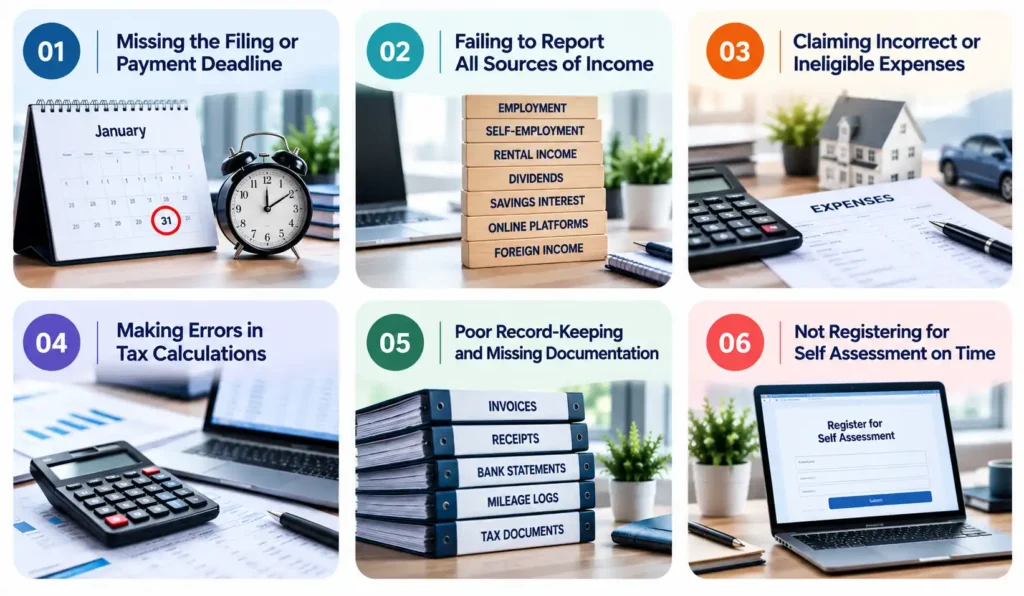
These are the most frequently occurring common Self Assessment errors identified by HMRC and accountants working with self-employed individuals, freelancers, and small businesses.
Missing the Filing or Payment Deadline
The online filing deadline is 31 January. The paper deadline is 31 October. Tax payment is also due by 31 January. Missing any of these triggers automatic penalties:
- £100 penalty for a return filed even one day late
- £10 per day after three months, up to £900
- Further percentage-based penalties at six and twelve months
- Interest on any unpaid tax from the payment deadline
The penalty applies even if no tax is owed. Filing early in November or December is the easiest way to avoid this.
Failing to Report All Sources of Income
Undeclared income is one of the most consequential Self Assessment tax errors. HMRC cross-references returns against data from banks, employers, and digital platforms. Commonly missed income includes:
- Freelance or consultancy earnings alongside employment
- Dividends from shareholdings
- Rental income from a property
- Bank interest above the Personal Savings Allowance
- Income from online platforms and marketplaces
- Foreign income
Working with tax services for self-employed individuals ensures all income categories are reviewed systematically before submission.
Claiming Incorrect or Ineligible Expenses
Allowable expenses must be incurred wholly and exclusively for business purposes. Common errors include:
- Claiming the full cost of a vehicle used for both personal and business journeys
- Including clothing that could be worn outside of work
- Claiming personal mobile phone bills in their entirety
- Overclaiming home office costs without applying the correct calculation
Overclaiming triggers HMRC scrutiny. Underclaiming means paying more tax than necessary. Both are avoidable with clear records and an understanding of what qualifies.
Making Errors in Tax Calculations
HMRC’s online portal calculates tax automatically, but only from the figures entered. Self Assessment tax calculation errors typically occur when:
- Figures are transposed or entered in the wrong box
- An income source is duplicated
- Previous year’s figures are carried over without checking for changes
- Returns are filed from memory rather than verified records
Always cross-reference entries against bank statements, P60S, invoices, and dividend certificates before submitting.
Poor Record-Keeping and Missing Documentation
HMRC requires Self Assessment taxpayers to keep records for at least five years after the filing deadline. Poor records pose a compliance risk and a practical issue: without documentation, you can’t respond to HMRC inquiries properly. Essential records include:
- Sales invoices and income records
- Receipts and purchase invoices for expenses
- Bank and credit card statements
- Mileage logs for business travel
- P60s, dividend certificates, and interest statements
Professional Bookkeeping Services keep these records organised throughout the year, so figures are already reconciled when the filing deadline arrives.
Not Registering for Self Assessment on Time
Filing requires registration, and registration is a separate process. New filers must register with HMRC by 5 October following the end of their first relevant tax year. Missing this deadline can itself result in a penalty and delays the issuance of a Unique Taxpayer Reference (UTR), without which the online return cannot be submitted.
Register early. HMRC UTR processing takes weeks, and late registration makes meeting the January filing deadline harder.
What Happens If You Make a Mistake on Your Self Assessment?
The outcome depends on whether the error is careless, deliberate, or concealed. HMRC’s penalty structure is:
- Up to 30% of unpaid tax for careless mistakes
- Up to 70% for deliberate errors
- Up to 100% for deliberate errors that are actively concealed
- Interest on outstanding tax from the original payment deadline, regardless of penalties
A serious error can also trigger a formal HMRC investigation covering previous tax years. If you identify a mistake and correct it promptly, penalty exposure is typically reduced or eliminated. Seeking support through Self Assessment tax return services before a problem escalates is almost always less costly than responding to a compliance check without professional help.
Mistakes can also result in overpaid tax. HMRC won’t automatically identify or refund overpayments; you must amend the return or file a claim.
How to Correct a Self Assessment Tax Return Error
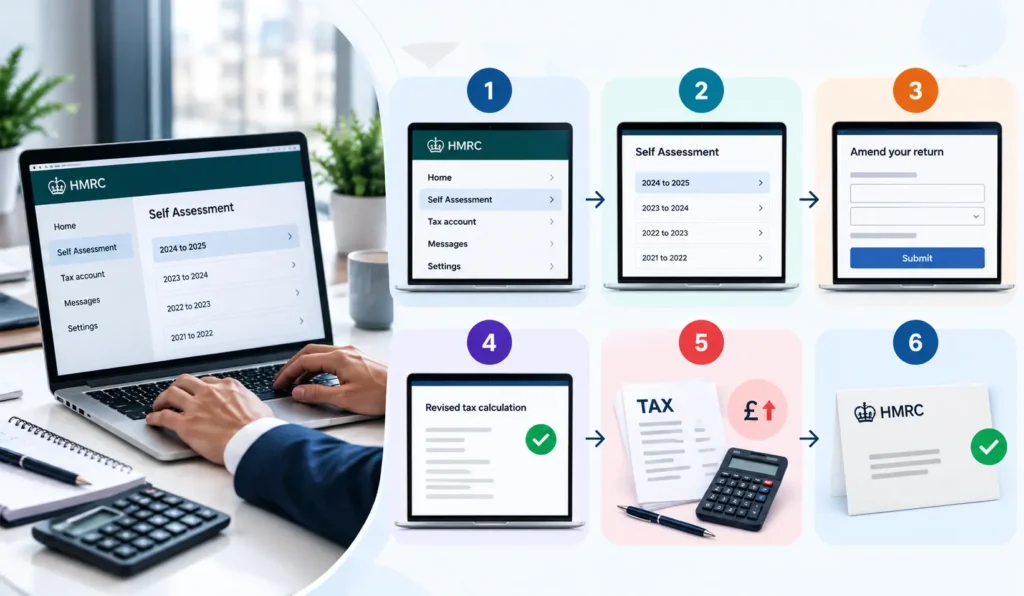
A submitted return can be amended online through your HMRC personal tax account within 12 months of the original 31 January filing deadline for that tax year. Log in, navigate to the relevant tax year, make the corrections, and resubmit. HMRC will issue a revised tax calculation. If the amendment results in additional tax owed, interest applies from the original payment deadline. If it results in a refund, HMRC will arrange repayment.
Outside the 12-month window, you must submit corrections in writing to HMRC. For errors involving undeclared income or multiple tax years, we strongly recommend seeking advice from UK tax return services before contacting HMRC. If you come forward proactively through HMRC’s Voluntary Disclosure process, penalties are typically lower than if HMRC identifies the error first.
How Professional Accounting Support Helps Prevent Self Assessment Errors
Working with an accountant who handles Self Assessment returns regularly is the most reliable way to avoid HMRC Self Assessment mistakes. A qualified accountant reviews every income source, applies the correct expenses rules, checks that all allowances and reliefs are claimed, and reconciles figures against documentation before submission. Self Assessment accounting services ensure self-employed and small business returns are correct before HMRC receives them.
Beyond the annual return, professional Tax Services include year-round advice on record-keeping, expense categorisation, National Insurance obligations, and tax planning. By the time the filing deadline arrives, the groundwork is done. No last-minute scrambles, no uncertainty, no guesswork.
For businesses with multiple income streams or a growing volume of transactions, Outsourced Accounting Services add oversight that catches errors before they reach HMRC and identifies reliefs a self-prepared return would miss.
Also Read: Top 10 outsourced accounting companies in the uk
Final Thoughts
Self Assessment mistakes are common, but they are not inevitable. Most errors, missed deadlines, undeclared income, and incorrect expense claims are caused by incomplete records or time pressure. Understanding the most common errors and why they occur is the first step to filing an accurate, compliant, and stress-free return.
Stellarwiz simplifies Self Assessment for UK self-employed individuals, freelancers, and small businesses, from year-round bookkeeping to accurate tax returns. Discuss how Stellarwiz can help you succeed with the team today.
Frequently Asked Questions
How can I avoid mistakes on my UK tax return?
Keep organised financial records throughout the year, review all income sources carefully, cross-reference every figure against bank statements and invoices, and file well ahead of the 31 January deadline. For complex income or expense structures, working with a qualified accountant removes most of the risk entirely.
What happens if I make a mistake on my Self Assessment tax return?
Penalties range from 0% for mistakes made despite reasonable care to up to 100% of unpaid tax for deliberate and concealed errors. Interest is charged on outstanding amounts from the original payment deadline. HMRC will not automatically refund overpaid tax; you must amend the return or file an overpayment relief claim.
How can I correct an incorrect Self Assessment tax return?
Amend it online through your HMRC personal tax account within 12 months of the original 31 January deadline. Log in, select the relevant tax year, make corrections, and resubmit. After the 12-month window, contact HMRC in writing. For errors involving undeclared income or multiple years, take professional advice before contacting HMRC.
What happens if I forget to declare income on my tax return?
HMRC cross-references returns against data from employers, banks, and digital platforms. HMRC regularly identifies undeclared income through this process. If HMRC discovers it, you may owe additional tax, interest, and penalties. If you discover it yourself, amending the return or making a voluntary disclosure before HMRC raises the issue significantly reduces the penalty risk.
Can I amend my Self Assessment tax return after submitting it?
Online amendments are allowed within 12 months of the 31 January deadline in your HMRC personal tax account. Written corrections are due after that window. Amending is free, but additional tax owed will accrue interest from the payment deadline.