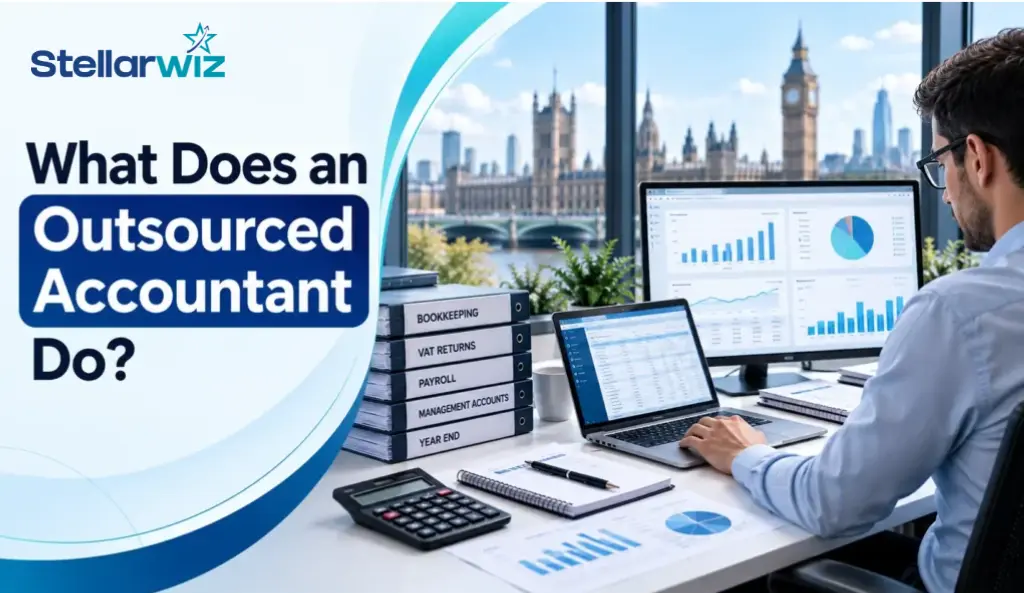
For most UK businesses and accounting firms, the question isn’t whether to use an outsourced accountant, but what they actually do once they are working on the account. The role covers far more than data entry. A trained outsourced accountant handles bookkeeping, bank reconciliations, VAT returns, payroll processing, management accounts, and year-end preparation, working within the client’s existing software and adapting to the firm’s workflow without requiring a new hire, a desk, or an employment contract.
Key Takeaways
- An outsourced accountant handles day-to-day tasks including bank reconciliations, invoice processing, VAT returns, payroll, and monthly management accounts.
- They integrate into Xero, QuickBooks, Sage, or FreeAgent without requiring a system or platform change.
- UK accounting firms outsource accountants to manage peak workloads and free senior staff for review, advisory, and client work.
- The client firm retains review and sign-off responsibility, while the outsourced accountant handles all underlying preparation work within the agreed scope.
- For growing businesses, an outsourced accountant provides qualified finance function support without the cost or management overhead of a full-time in-house hire.
A Day in the Life of an Outsourced Accountant
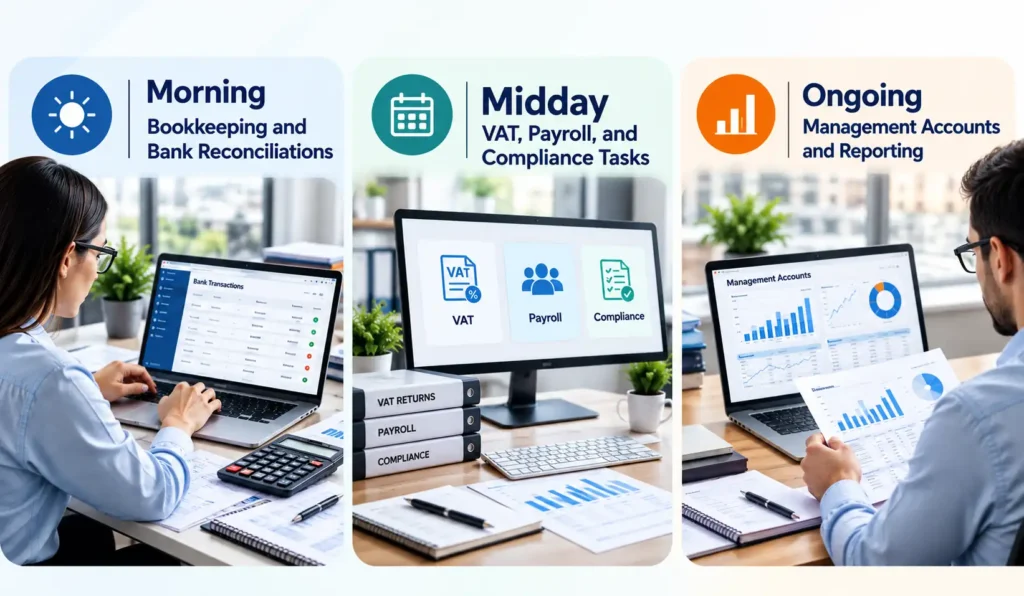
Here is what a day looks like for an outsourced accountant:
Morning: Bookkeeping and Bank Reconciliations
The day typically starts with coding transactions from the previous day’s bank feed and processing any invoices that came in overnight. Outsourced bookkeeping services cover this stage systematically, keeping the ledger current, matching receipts, and flagging discrepancies before they compound. For clients on weekly reconciliation cycles, this morning work is what keeps the accounts accurate enough to support real-time reporting rather than a historical view at month end.
Midday: VAT, Payroll, and Compliance Tasks
Periodic compliance tasks run as a consistent thread through the week. VAT returns are prepared on the quarterly cycle, drawing from the reconciled ledger rather than raw transaction data. Payroll is processed to the agreed schedule, weekly or monthly, with PAYE submissions handled as part of the same workflow. The outsourced accountant follows internal checklists and submission deadlines, reducing the risk of missed filings and the penalties that follow from preparation errors at this stage.
Ongoing: Management Accounts and Reporting
Management accounts are prepared monthly, drawing together reconciled transactions, payroll data, and any accruals or prepayments to give the business a clear view of performance against budget. These are produced to a template agreed at the start of the engagement, so the business owner or practice receives the same format each month and can track trends without rebuilding the report from scratch. This reporting layer is what moves an outsourced accounting engagement beyond bookkeeping into genuine financial support.
How an Outsourced Accountant Works with a UK Business or Practice
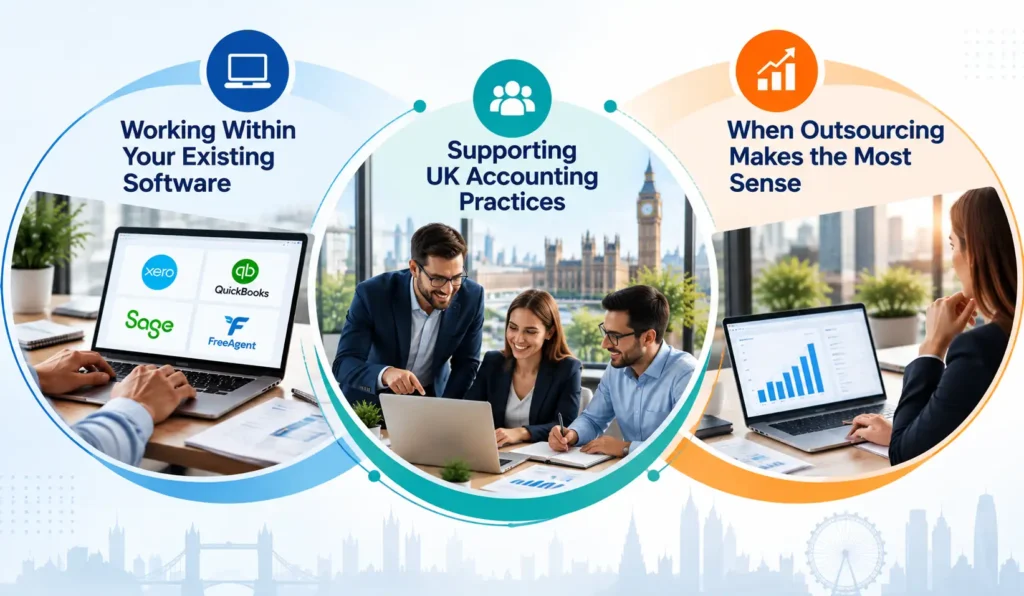
Here is how an outsourced accountant works with a UK business or practice:
Working Within Your Existing Software
One of the most common questions about outsourced accounting is whether it requires switching systems. It does not. Outsourced accountants work within Xero, QuickBooks, Sage, and other cloud platforms through secure access, handling the transactional layer while the client retains control of the data and the account. Outsourced accounting services UK are designed to integrate with the client’s existing workflow rather than disrupt it, which helps keep the arrangement manageable for businesses and practices already mid-cycle.
Supporting UK Accounting Practices
UK accounting practices use outsourced accounting teams to manage capacity without adding to their permanent headcount. The model is particularly effective during the January self-assessment peak and around year-end deadlines, when workload spikes sharply, and the cost of missing a deadline falls on the practice. The outsourced accountant prepares reconciliations, draft accounts, and VAT summaries, while the practice’s staff reviews, communicates with clients, and signs off.
When Outsourcing Makes the Most Sense
Outsourced accounting for UK firms suits a range of situations: a growing business that needs more finance support than a bookkeeper can provide but is not ready for a full-time finance manager; an accounting practice that wants to expand its client base without hiring ahead of confirmed revenue; or a business owner who needs accurate monthly reporting without the salary, NI, and pension costs of a permanent employee. The common thread is qualified accounting capacity at a cost that reflects actual usage, not fixed employment overhead.
Stellarwiz works with UK businesses and accounting practices across all of these situations, providing outsourced accounting support that integrates with existing workflows and scales with the client’s requirements.
Final Thoughts
Understanding what an outsourced accountant actually does is what separates a well-managed outsourcing arrangement from one chosen on price alone. Any business or accounting practice relies on daily tasks like bookkeeping, reconciliations, VAT, payroll, and management accounts. An outsourced accountant delivers those tasks accurately and on schedule, within the client’s existing systems, without the employment commitments of an in-house hire.
Also Read: Top 10 outsourced accounting companies in the uk
Frequently Asked Questions
What does an outsourced accountant actually do?
An outsourced accountant handles the full range of day-to-day and periodic accounting tasks: bookkeeping, bank reconciliations, VAT returns, payroll processing, management accounts, and year-end preparation.
Is outsourced accounting suitable for small businesses?
Yes. Outsourced accounting suits small and growing businesses that need qualified finance support beyond basic bookkeeping but are not yet at the stage where a full-time in-house accountant is cost-justifiable.
Can UK accounting practices outsource bookkeeping and accounting work?
Yes. Many UK accounting firms outsource reconciliations, draft accounts, VAT returns, and payroll while their staff handles review, advisory, and client management.
How does an outsourced accountant work with a UK accounting firm?
The outsourced accountant is given secure access to the firm’s client files through the existing cloud accounting software. They handle preparation and transactional work to an agreed scope and timeline, and the firm’s own accountants review, advise, and sign off.
What is the difference between an outsourced accountant and an in-house accountant?
An outsourced accountant delivers the same accounting tasks as an in-house hire but under a services agreement rather than an employment contract. There is no PAYE obligation, no employer NI or pension contribution, and no management overhead.