The Sage vs Xero question comes up early for almost every UK startup that needs accounting software. Both are well-established platforms with strong UK feature sets, Making Tax Digital compliance, and a broad base of accountants and bookkeepers who work with them daily. The practical question for a startup founder is not which platform is theoretically superior, but which one best matches the business as it is now and where it is heading over the next two to three years.
Key Takeaways
- Xero consistently rates higher for ease of use, mobile access, and third-party integrations, making it the default choice for most UK startups without complex operational requirements.
- Sage offers a broader built-in feature set, including payroll and HR functionality, which can reduce the need for additional software in businesses with larger teams or specific compliance needs.
- Both platforms are MTD-compliant and can handle UK VAT returns, payroll, bank reconciliation, and financial reporting for growing businesses.
- The choice between Sage and Xero often matters less than the quality of the accounting support behind it: consistent bookkeeping and a well-structured chart of accounts deliver better results on either platform.
- For UK startups not ready for a full-time finance hire, outsourced accounting support on either Sage or Xero provides the full bookkeeping, VAT, and reporting function at a cost that reflects actual usage rather than fixed employment terms.
Sage vs Xero: Key Differences for UK Startups
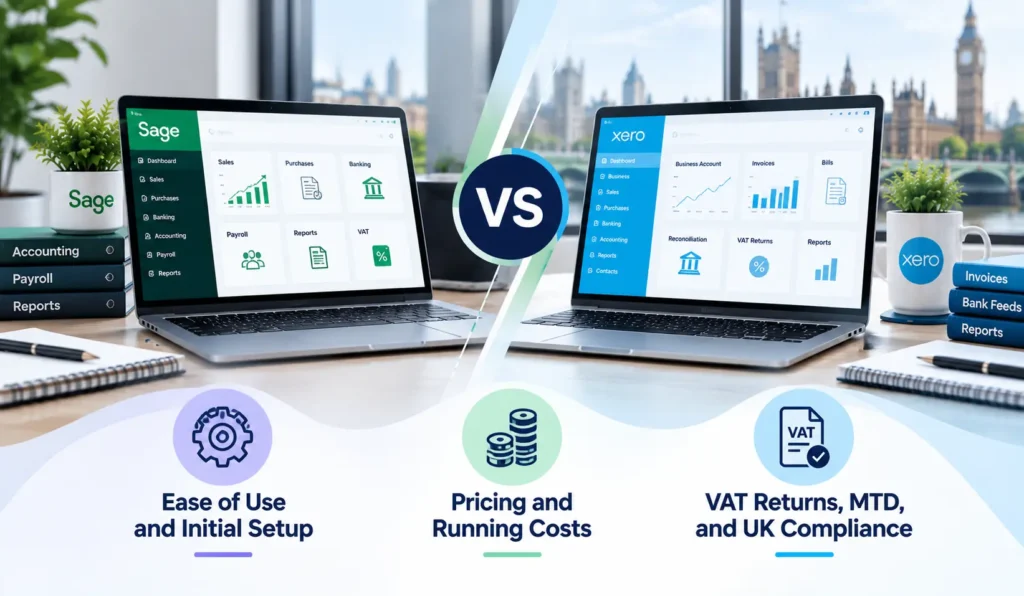
The comparison between Sage and Xero is most useful when focused on what matters most to a startup: day-to-day usability, running costs, and how well each platform handles UK compliance requirements.
Ease of Use and Initial Setup
Xero is consistently rated as the more accessible platform for business owners without an accounting background. Its interface is designed around simplicity, with bank feeds, invoicing, and reconciliation workflows that new users can navigate without specialist training. Sage provides more built-in functionality but requires a longer setup period to configure correctly, which can slow initial adoption for a startup team with limited time to invest in software implementation. For most founders new to accounting software, Xero accounting software offers the lower-friction path.
Pricing and Running Costs
Both Sage and Xero offer accounting plans designed to support businesses at different stages of growth. The features available depend on the selected plan, with options for invoicing, bank reconciliation, financial reporting and VAT management. Sage may suit businesses looking for specific built-in payroll and HR capabilities, while Xero is a strong option for startups prioritising ease of use and third-party integrations. The best choice depends on your business requirements and preferred accounting workflow.
VAT Returns, MTD, and UK Compliance
Both Xero and Sage are Making Tax Digital compliant and support direct VAT return submission to HMRC. Xero’s MTD workflow is designed for accessibility: VAT returns are prepared from reconciled transactions and submitted in a few steps, making the quarterly cycle manageable for business owners handling their own compliance. For startups that prefer to delegate the entire VAT process, outsourced bookkeeping services cover VAT preparation and submission on either platform as part of the standard bookkeeping engagement, removing the compliance burden from the founder entirely.
Which Platform Should a UK Startup Choose?
The answer depends more on the startup’s operational profile than on the platforms themselves. The following covers when each tends to perform better and when professional accounting support changes the decision.
When Xero Is the Better Fit
Xero for startups works well for most service-based UK startups: businesses that invoice clients, track expenses, run straightforward payroll, and need clean financial reporting without complex inventory or multi-entity requirements. Its integration marketplace connects easily with CRM, project management, and e-commerce tools as the business scales. For a founder who wants to maintain a working understanding of their finances without needing an accountant to interpret the interface, Xero is the lower-friction option and the more common starting point for UK startups.
When Sage Is the Better Fit
Sage suits businesses with more complex operational requirements: those that need inventory management, multi-currency transactions, or integrated payroll and HR within a single platform. It performs well for businesses in sectors with specific compliance requirements and those anticipating significant near-term headcount growth. Setup time and configuration costs are front-loaded, but for businesses that can commit, Sage offers a more complete built-in toolset without requiring as many third-party integrations to match what Xero assembles across its app marketplace.
Outsourced accounting services UK for startups provide the full Xero bookkeeping, VAT, payroll, and management accounts function without the fixed employment cost of a permanent in-house hire. The platform, whether Xero or Sage, is the environment in which that work is delivered, not the primary factor in its quality.
The Role of Outsourced Accounting Support

For most UK startups, the quality of the best accounting software for startups matters more than the platform choice. Management Accounts prepared monthly on either Xero or Sage give the business the same performance visibility, provided the underlying bookkeeping is accurate and up to date. The platform can’t apply judgement to transaction coding, flag reconciliation issues before they compound, or produce reporting that gives a clear picture of the business rather than a raw summary of transactions.
UK Accounting Firms that specialise in outsourced accounting work across both Xero and Sage, handling Sage bookkeeping, VAT, payroll preparation, and draft accounts while practice staff focus on review, advisory, and client-facing responsibilities. This model is particularly effective during January self-assessment peaks and year-end periods when workload spikes and the cost of a missed deadline falls on the firm.
Final Thoughts
The Sage vs Xero decision is worth making carefully, but it is not the most consequential decision a UK startup makes about its finances. Either platform, maintained accurately and reviewed regularly, provides the compliance function and financial visibility a growing business needs. The more significant decision is whether the bookkeeping and accounting behind the platform is being handled to the standard the business requires.
Stellarwiz works with UK startups and accounting practices across both Xero and Sage, providing outsourced accounting support that integrates with existing software, scales with the client’s requirements, and delivers accurate, timely reporting regardless of which platform the business has chosen.
Frequently Asked Questions
What is the difference between Sage and Xero?
Sage and Xero are cloud-based accounting platforms that handle bookkeeping, invoicing, bank reconciliation, VAT, and financial reporting for UK businesses. Xero is more accessible for non-accountants and integrates with a wider range of third-party tools, while Sage offers more built-in functionality, including payroll and HR.
Is Sage or Xero better for startups?
Xero is the more common choice for UK startups because of its ease of use, clean interface, and large app ecosystem. However, the better answer depends on the startup’s specific profile.
Which is easier to use, Sage or Xero?
Xero is consistently rated as the easier platform for business owners without an accounting background. Sage offers more features in the core platform but requires a longer setup period and is more likely to need specialist support.
Is Xero cheaper than Sage?
Both platforms have comparable entry-level pricing, starting at around £15 to £16 per month excluding VAT. Sage may represent better value for businesses that need payroll included, since it bundles payroll functionality at lower additional cost in some configurations.
Can Sage and Xero handle VAT returns?
Yes. Both Sage and Xero are Making Tax Digital compliant and support direct VAT return submission to HMRC. Both platforms prepare the VAT return from reconciled transactions and allow direct digital submission through the MTD portal.