
UK practices are increasingly comparing offshore accounting services vs local accounting for reasons beyond cost alone. Both models have a legitimate place depending on a practice’s structure, growth stage, and the type of work it needs to delegate. For most UK accounting firms, the question is no longer whether offshore delivery is credible but how it compares in practice to local alternatives across the criteria that matter: cost, quality, flexibility, and the range of work that can be reliably handled without a UK-based employee in the role.
Key Takeaways
- Offshore accounting services deliver the same bookkeeping and compliance tasks as local alternatives at materially lower cost, with the difference reflecting labour market rates rather than any difference in qualification or output standard.
- Specialist providers with HMRC-experienced staff and MTD-compliant accounting software now handle transaction processing, VAT returns, payroll, management accounts, and year-end preparation offshore.
- Local accounting resources remain better suited to direct client contact, advisory work, and final review and sign-off: the tasks where relationship and professional judgement outweigh the cost advantages of offshore delivery.
- Data security and GDPR compliance are addressable concerns rather than structural barriers, with reputable offshore providers operating under documented security frameworks and contractual data protection obligations consistent with UK standards.
- The practices that benefit most from offshore accounting are those managing variable workloads: firms facing predictable January and year-end peaks, or those growing faster than their local recruitment pipeline can support at viable cost.
Offshore Accounting Services vs Local Accounting: What the Comparison Actually Covers
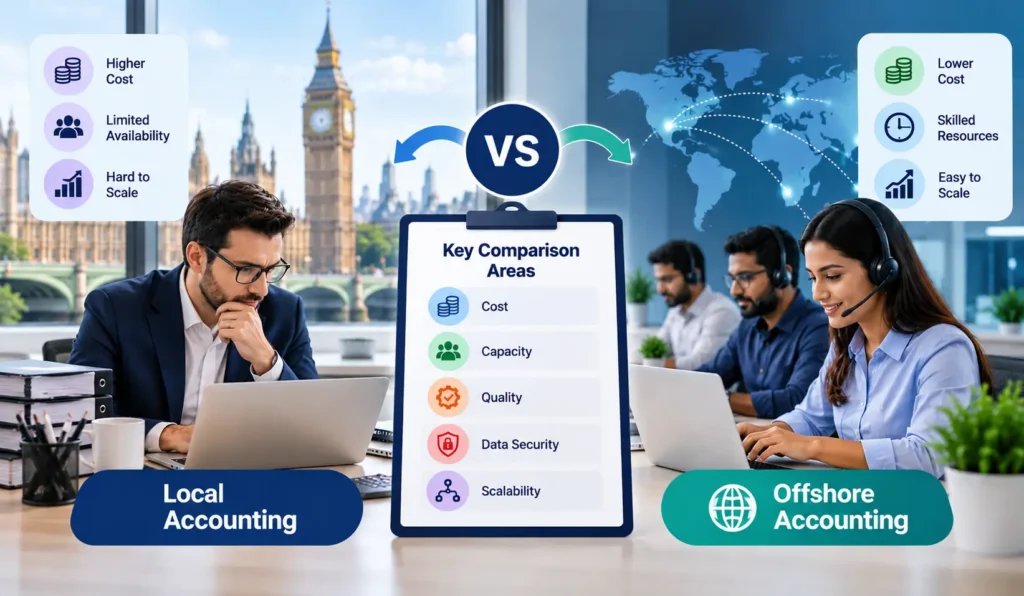
Before comparing the two models on cost and capability, it helps to be precise about what each means for a UK accounting practice.
What Local Accounting Means for a UK Practice
Local accounting, in this context, means the resource a practice uses when it recruits, employs, or subcontracts work to UK-based bookkeepers and accountants. For most practices, local resources are expensive: salaries for UK bookkeepers and junior accountants sit well above the cost of equivalent offshore capacity, and employment costs including National Insurance contributions, pension contributions, and paid leave add a further layer of overhead. Local recruitment has also become increasingly difficult across competitive UK labour markets, where qualified accounting staff have options and smaller practices cannot always match the packages offered by larger firms or corporate finance teams. The result is a local resource that is both costly and hard to scale.
What Offshore Accounting Means for a UK Practice
Offshore accounting means delegating processing-intensive accounting work to a specialist provider based outside the UK, typically in a jurisdiction with a large pool of English-speaking, accounting-qualified professionals. The offshore team works within the practice’s existing software environment, following the same workflows, coding standards, and reporting formats the practice uses internally. UK-based staff review the work before it reaches the client. Turnaround times for routine bookkeeping, VAT, and payroll work are aligned with UK working hours, and the quality of output reflects the provider’s investment in training, quality control, and UK-specific accounting knowledge. The offshore team is not a replacement for the practice’s advisory function; it is a delivery resource for the process-led work that makes up the largest share of most practices’ time.
The Real Basis for Comparison
Comparing offshore and local accounting on cost alone misses the operational dimension that makes offshore models useful. The more relevant comparison is between flexible, scalable offshore resources that adjust to the practice’s workload and a fixed local cost that does not. A UK practice paying for local staff year-round to cover the January self-assessment peak and the year-end concentrations absorbs cost across the quieter months that an offshore model would not carry. The comparison shifts when the practice maps its workload across the full year rather than pricing it against the peak period alone. At that level of analysis, the case for offshore accounting is less about hourly rates and more about structural efficiency across the full annual cycle.
Cost, Capacity, and Quality: How the Two Models Compare

The comparison between offshore and local accounting is most useful across three practical dimensions: what each model costs, how each responds to changes in workload, and what assurances each offers on output quality and data security.
The Cost Case for Offshore Accounting
The cost difference between offshore and local accounting resources is material and consistent across the full range of bookkeeping and compliance services. UK accounting practices pay significantly more for equivalent output when they recruit and employ locally than when they engage an offshore accounting partner at rates that reflect labour costs in the provider’s jurisdiction. For a practice handling a regular volume of transaction processing, VAT returns, and payroll each month, the difference between local and offshore delivery cost can represent a substantial proportion of the practice’s total staffing overhead. Offshore accounting services for UK accounting firms delivered at fixed per-hour or per-job rates also provide cost predictability that variable local staffing does not, removing the overhead uncertainty that comes with employment alongside the cost reduction itself.
Capacity Management and Scalability
Local accounting resources scale poorly against demand. A practice that employs two bookkeepers has two bookkeepers’ capacity regardless of whether the workload justifies it this month or this quarter. Offshore accounting scales with demand: the practice draws on more resources during peak periods and less during quieter months, with costs that reflect actual usage rather than a fixed employment commitment. For growing practices adding clients faster than their local recruitment pipeline can support at viable cost, offshore accounting provides the capacity bridge that internal hiring cannot. Outsourced accounting services through an established offshore provider also remove the onboarding costs of local recruitment: there is no training period, no notice-period risk, and no interruption to client service when a local staff member leaves.
Quality, Security, and UK Compliance
The concern that offshore accounting produces lower-quality output is best addressed by understanding the nature of the work being delivered. Bookkeeping, VAT return preparation, payroll processing, and year-end support are process-led tasks with defined inputs, clear outputs, and built-in review stages. An offshore provider follows a practice’s coding standards and workflow documentation, works in the same cloud accounting software, and produces output that UK-based staff review before it reaches the client. This review function is where local expertise applies its judgement; the offshore function handles volume and process precision most efficiently. Data security concerns are addressed through GDPR-compliant engagement structures, secure file transfer protocols, and contractual data protection obligations. Outsourcing accounting for UK practices through a provider with documented security frameworks and a track record across UK client portfolios carries risk levels comparable to those of any UK-based outsourced accounting engagement.
Which Accounting Tasks Work Well Offshore?

Not all accounting work suits offshore delivery equally well. The tasks that move offshore most effectively share a common profile: they are process-led, software-based, and well-defined in terms of inputs and expected outputs. The following covers the three categories that make up most of the work UK practices regularly delegate offshore.
Bookkeeping and Transaction Processing
Day-to-day bookkeeping is the most consistently delivered offshore accounting task because it is structured, software-based, and measurable in terms of accuracy and turnaround. Bank feeds, invoice processing, supplier reconciliation, and payroll journals follow documented workflows that an offshore team learns quickly and executes reliably at volume. For UK practices handling bookkeeping across a client base of mixed sizes and industries, offshore support relieves pressure on internal staff while maintaining the consistency clients expect. Bookkeeping outsourcing services from an established offshore partner also improve turnaround reliability during busy periods, since offshore capacity isn’t subject to the same leave, illness, and competing-deadline pressures that affect small local teams.
VAT Returns, Payroll, and Compliance Work
VAT return preparation, payroll processing, and self-assessment returns are the next tier of work that moves offshore effectively. HMRC thresholds, MTD submission requirements, and payroll legislation are UK-specific, but these rule-based and process-led tasks can be offshored once the provider understands the practice’s standards and client base. The practice retains review and submission, while the offshore team handles preparation, leaving UK-based staff to focus on advisory and client-facing work that requires direct relationships and professional judgement. Outsourced accounting for UK firms covers the full compliance cycle, from bookkeeping to VAT and payroll to year-end, providing a consistent offshore resource.
Management Accounts and Year-End Support
Management accounts preparation and year-end support require more client-specific context than routine bookkeeping, but practices regularly deliver them offshore through established workflows and mature offshore relationships. The offshore team prepares draft accounts from reconciled data, and the UK-based reviewer checks, adjusts, and finalises before the client sees the output. This model is particularly effective during the year-end concentration period, when UK-based staff would otherwise be stretched across too many client files simultaneously. Offshore support during peak periods reduces the risk of delayed accounts and missed filing deadlines without the cost of retaining surplus local capacity year-round to cover a workload that only materialises for a fraction of the annual calendar.
Final Thoughts
The choice between offshore accounting services vs local accounting is most usefully made as a structural decision rather than a cost comparison alone. For UK practices managing variable workloads, growing faster than their local recruitment pipeline can support, or looking to improve capacity across the year-end and January self-assessment peaks, offshore accounting provides a reliable, qualified delivery resource that local alternatives cannot match on cost or flexibility.
Stellarwiz provides outsourced accounting support to UK businesses and accounting practices across the full bookkeeping and compliance cycle, working within existing software environments and delivering accurate, timely output that integrates with each practice’s own review and client-facing processes.
Frequently Asked Questions
What is the difference between offshore and local accounting services?
Offshore accounting services involve delegating bookkeeping, VAT, payroll, and compliance work to a specialist provider based outside the UK. For a UK accounting practice, the practical difference is cost, scalability, and the type of work each model handles best: offshore delivery suits process-intensive, volume-based tasks, while local resources suit direct client contact, advisory work, and final review and sign-off.
Is offshore accounting cheaper than local accounting?
Offshore accounting costs significantly less than equivalent local resources. The difference reflects UK salary levels and employment overheads compared to the labour costs in offshore jurisdictions, and it is consistent across the full range of bookkeeping and compliance services.
Why do UK accounting firms use offshore accounting services?
UK accounting firms use offshore accounting services to manage three interconnected pressures: cost, capacity, and recruitment. Offshore accounting addresses all three: it provides qualified capacity at a lower cost, scales with demand, and doesn’t depend on a competitive UK recruitment market.
What are the benefits of offshore accounting for UK accounting practices?
The main benefits are lower costs, flexible capacity, and operational continuity. Cost reduction comes from the difference in labour rates between the UK and offshore jurisdictions. Capacity flexibility comes from the offshore model’s ability to scale up and down with the practice’s workload rather than carrying fixed local headcount.
Can offshore accountants work with UK accounting software?
Yes. Reputable offshore accounting providers work across the full range of cloud accounting software used by UK practices, including Xero, QuickBooks, and Sage. MTD-compliant VAT submission, Making Tax Digital workflows, and UK-specific reporting formats are standard capabilities for offshore providers that specialise in UK accounting practices.