Running a business means making decisions constantly. Where to grow, who to hire, how to manage costs. And somewhere in the middle of all that, your bookkeeping quietly demands attention every single month.
At first, it feels manageable. A handful of transactions. A simple spreadsheet. Maybe basic accounting software. But as the business grows, so does the complexity, invoices stacking up, reconciliations falling behind, VAT deadlines creeping closer. One missed entry can throw off your entire reporting.
So the question becomes: do you bring someone in-house, or do you hand it to an external team?
Both options work. But they work very differently depending on your size, your budget, and how much hands-on control you need over your finances. Get it right, and your books run quietly in the background. Get it wrong, and it costs you more than just money.
This blog breaks down both sides honestly, so you can make the right call for your business.
Key Insight
- Outsourced bookkeeping vs in-house bookkeeper comparison clearly explains differences in cost, control, scalability, and expertise for growing businesses
- Outsourced bookkeeping services for small businesses offer cost savings of up to 15-30% compared to hiring a full-time in-house bookkeeper
- Virtual and remote bookkeeping services provide flexible, technology-driven financial record-keeping using cloud accounting software
- In-house bookkeeping vs outsourcing highlights how internal teams offer control, while outsourcing brings access to experts and scalable bookkeeping solutions for SMEs
What is Outsourced Bookkeeping?
Outsourced bookkeeping simply means hiring an external expert or a bookkeeping outsourcing company to manage your financial records instead of handling them in-house.
So instead of employing a full-time bookkeeper, clients choose virtual bookkeeping services or remote bookkeeping services where a professional team handles everything, from recording transactions to preparing reports.
57% of UK organisations plan to increase the level of business processes outsourced to third parties, with accounting and finance services set to see the greatest uptake of new business.
In simple terms,
Your books are managed by experts outside your business, but everything still stays organised, accurate, and accessible to you.
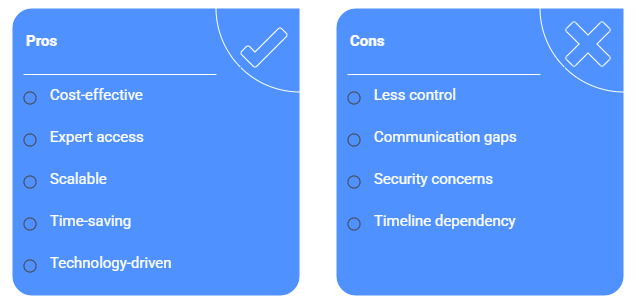
Pros of Outsourced Bookkeeping
- Cost-effective, no salaries, benefits, or training costs
- Access to experts, skilled professionals with updated knowledge
- Scalable, easy to increase or reduce services as the business grows
- Time-saving, frees up internal resources
- Technology-driven, uses modern tools and automation
As per IAOP (International Association of Outsourcing Professionals), companies report average cost savings of 15–30% through outsourcing.
Cons of Outsourced Bookkeeping
- Less direct control compared to an in-house team
- Communication gaps, if not managed properly
- Data security concerns (important to choose a reliable provider)
- Dependency on external team timelines
Outsourced bookkeeping works best when our clients want flexibility, expertise, and efficiency without the commitment of building a full internal accounting team.
What is an In-House Bookkeeper?
An in-house bookkeeper is someone you employ directly, full-time or part-time, to manage your financial records from within your business.
They sit inside your team. They know your workflows, your suppliers, your quirks. When you need something, you walk over and ask. There’s no brief to write, no email chain, no waiting.
For businesses that need constant, hands-on financial involvement day to day, that proximity has real value.
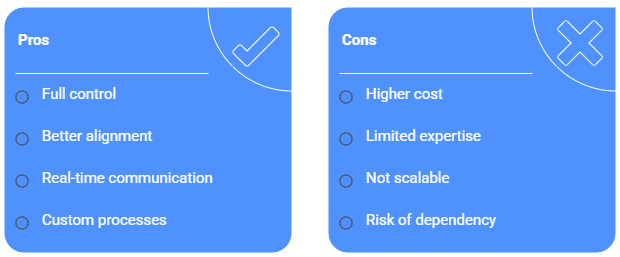
Pros of an In-House Bookkeeper
- Full control – Direct supervision and immediate access
- Better alignment – Deep understanding of business operations
- Real-time communication – Faster coordination with internal teams
- Custom processes – Can adapt to company-specific workflows
Cons of an In-House Bookkeeper
- Higher cost – Salary, benefits, training, and infrastructure
- Limited expertise – Depends on one person’s skill set
- Not easily scalable – Hiring more staff as the workload grows
- Risk of dependency – Work may get disrupted if the employee leaves
Outsourced Bookkeeping vs In-House Bookkeeper: Key Differences Explained
When clients compare outsourced bookkeeping vs. an in-house bookkeeper, the decision usually comes down to how they want to manage time, cost, control, and growth.
Both options handle essential tasks like financial record keeping, general ledger management, accounts payable services, and financial reporting services. But the way they operate and the impact they have on the business are very different.
Here’s a clear side-by-side comparison to help understand what fits best:
| Basis | Outsourced Bookkeeping | In-House Bookkeeper |
| Setup | External team or bookkeeping outsourcing company | Full-time or part-time internal employee |
| Cost | Lower, flexible pricing based on services | Higher (salary, benefits, training, infrastructure) |
| Expertise | Access to a team of experts across areas | Limited to one person’s knowledge and experience |
| Scalability | Easily scalable as the business grows | Requires hiring more staff to scale |
| Technology | Uses advanced cloud accounting software and automation | Depends on the company’s internal systems |
| Control | Less direct control, managed remotely | Full control and supervision |
| Availability | Available as per the service agreement | Available during working hours |
| Flexibility | High flexibility with remote bookkeeping services | Less flexible, fixed role and responsibilities |
| Risk | Lower risk due to team-based approach | Higher dependency on one employee |
| Communication | Requires structured communication | Direct, real-time communication |
| Best For | SMEs, startups, and growing businesses | Businesses needing constant on-site support |
When we look at it closely, the choice isn’t about which is better overall; it’s about what works better for the stage and structure of the business.
For many small businesses exploring bookkeeping services for small businesses, outsourcing often brings the right balance of cost, expertise, and flexibility.
But for businesses that need daily, hands-on financial involvement, an in-house bookkeeper can feel more aligned.
Cost of outsourced bookkeeping vs. an in-house bookkeeper
When our clients compare the cost of outsourced bookkeeping vs. an in-house bookkeeper, the difference is often more than just numbers; it’s about how those costs scale with the business.
Here’s a simple comparison:
| Cost Factor | Outsourced Bookkeeping | In-House Bookkeeper |
| Monthly Cost | Flexible (£300 – £1,500+ depending on services) | Fixed (£2,000 – £4,000+ salary equivalent) |
| Salary & Benefits | Not applicable | Salary, bonuses, insurance, paid leaves |
| Hiring & Training | No hiring or training costs | Recruitment, onboarding, and training costs |
| Infrastructure Cost | Not required | Office space, system setup, software |
| Software & Tools | Usually included (cloud accounting software) | Additional cost for licenses and tools |
| Scalability Cost | Pay as you grow | Additional hiring required |
| Hidden Costs | Minimal and predictable | High (attrition, downtime, errors) |
| Overall Cost Efficiency | High (pay only for what you use) | Lower due to fixed overheads |
Final Thoughts on Choosing Outsourced Bookkeeping vs. an In-House Bookkeeper.
Businesses that get their bookkeeping right, whether in-house or outsourced, don’t just save money. They make better decisions, faster. They spot problems before they become expensive. They stop reacting and start planning.
The ones that get it wrong keep patching the same gaps, month after month, hoping it holds.
If an in-house bookkeeper gives you the control and closeness your business needs right now, go that way. Build the internal setup, invest in the right person, and own it fully.
But if the cost feels heavy, the expertise feels limited, or the flexibility just isn’t there, outsourcing is worth a serious look. That’s exactly where Stellarwiz comes in. As an outsourcing bookkeeping services provider in the UK, we handle the complexity so you don’t have to.
Either way, don’t wait for the next mistake to make the decision for you.
Frequently Asked Questions
Is outsourced bookkeeping cheaper than hiring a full-time bookkeeper?
Yes, in most cases, outsourced bookkeeping is cheaper than hiring staff. Our clients save on salaries, benefits, training, and infrastructure. With outsourced bookkeeping for small businesses, you only pay for the services you need, making it a more cost-effective option.
When should a business outsource bookkeeping services?
A business should consider bookkeeping outsourcing services when financial tasks start taking too much time, errors increase, or the costs of hiring internally become too high. It’s especially useful for growing businesses looking for bookkeeping solutions for SMEs that can scale easily.
What services are included in outsourced bookkeeping?
Businesses that get their bookkeeping right, whether in-house or outsourced, don’t just save money. They make better decisions, faster. They spot problems before they become expensive. They stop reacting and start planning.
The ones that get it wrong keep patching the same gaps, month after month, hoping it holds.
If an in-house bookkeeper gives you the control and closeness your business needs right now, go that way. Build the internal setup, invest in the right person, and own it fully.
But if the cost feels heavy, the expertise feels limited, or the flexibility just isn’t there, outsourcing is worth a serious look. That’s exactly where Stellarwiz comes in. As an outsourcing bookkeeping services provider in the UK, we handle the complexity so you don’t have to.
Either way, don’t wait for the next mistake to make the decision for you.
Can outsourced bookkeepers manage payroll and VAT returns?
Yes, a reliable bookkeeping outsourcing company can handle payroll management services and VAT returns. Many accounting outsourcing services also ensure compliance with local tax regulations, making the process smooth and accurate for businesses.