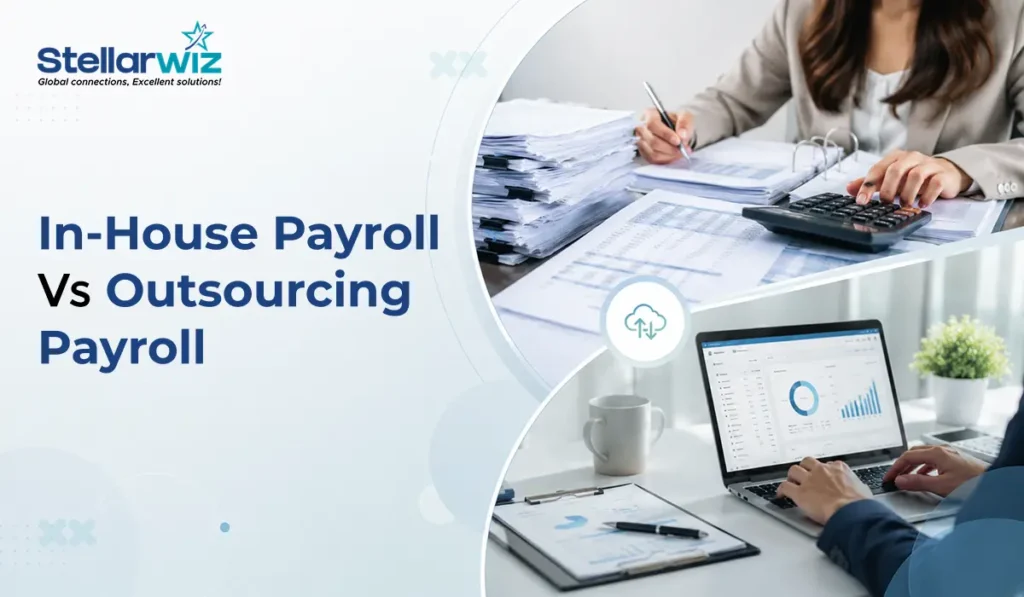
Payroll sounds easy: just make sure you pay your employees correctly and on time. But behind every payslip is a web of tax codes, PAYE management, compliance deadlines, and ever-changing legislation. Get it wrong and the consequences are real. A survey of 1,000 small business leaders found that payroll errors affected 84% of UK SMEs, with 40% incurring penalties costing thousands of pounds. Also, more than 69% of businesses are now thinking about outsourcing most or all of their payroll tasks.
So where does that leave you? If you’re weighing up in-house payroll vs outsourcing, this guide breaks down the real costs, risks, and benefits of each approach.
Key Takeaways
- 84% of small UK businesses make payroll mistakes, and 40% incur large fines as a result. This means that strong payroll processes are not a choice, they are a must.
- In-house payroll offers control and visibility but carries hidden costs in staff time, training, software, and error correction.
- Outsourcing payroll gives you expert accuracy, built-in compliance, and time savings, which are especially helpful as your business grows.
- The real payroll cost comparison goes beyond software fees; factor in staff hours, error correction, and compliance risk.
- Outsourced payroll services are increasingly viable for SMEs of all sizes, not just large enterprises.
What Is In-House Payroll?
When your business does its own payroll, it’s called “in-house payroll.” This can be done with dedicated payroll software, a payroll management system, or, for many smaller businesses, a spreadsheet. Your team is responsible for calculating wages, managing deductions, filing returns with HMRC, and staying on top of every regulatory change.
The appeal is clear: full control, immediate visibility, and no third-party fees. But that control comes with a price.
The Real Pros and Cons of In-House Payroll
Where it works well:
Running payroll in-house gives you complete oversight of employee payroll data. Sensitive information stays internal, and adjustments can be made instantly without waiting on an external payroll service providers. For very small businesses with a fixed, simple workforce and someone confident in payroll administration, this can be a manageable and cost-effective route.
Where it breaks down:
The hidden costs are pretty big. Businesses usually have to fix about 15 mistakes every pay period, and it costs around $291 to do so. This means that administrative waste can quickly reach over $4,000 per month, even before any fines are taken into account.
Beyond cost, there’s the compliance burden. HMRC’s RTI requirements, National Insurance contribution changes, auto-enrolment rules, and National Minimum Wage updates mean your internal team must continuously upskill. And if your payroll lead is sick or leaves the business, that knowledge walks out the door with them. Top Payroll Mistakes Small Businesses make are almost always rooted in this exact vulnerability.
What Is Outsourced Payroll?
Payroll outsourcing means handing your payroll function to a specialist external provider. They handle everything from gross-to-net calculations and payslip generation to payroll tax filing, pension submissions, and HMRC reporting. Depending on the provider, outsourced payroll services can be fully managed or co-managed, where your team retains some involvement.
The Benefits of Outsourcing Payroll Services
here are some of the benefits of outsourced payroll services:
- Accuracy and compliance: Professional payroll providers are specialists. They track legislative changes in real time and build compliance into their processes. For businesses worried about PAYE management and payroll compliance, this removes an enormous amount of risk.
- Time savings: Payroll administration is time-consuming. Outsourcing frees your team to focus on core business activities rather than chasing tax codes.
- Scalability: As your headcount grows, your payroll complexity grows with it. Outsourcing payroll is great for businesses that are growing because the service provider can grow with you without having to make any changes to your own staff.
- Cost predictability: Rather than absorbing the variable costs of errors, penalties, and software licences, you pay a fixed fee. For a fuller breakdown, see Benefits of Outsourced Payroll Services.
- Less risk: Mistakes don’t just cost money. HMRC fines for missing or wrong payroll information are between £100 and £400 per month, and they apply to each PAYE scheme if there are more than one. Outsourcing dramatically reduces that exposure.
Payroll Outsourcing vs In-House: Cost Comparison
Many business owners assume in-house payroll is cheaper. The reality is more nuanced. In-house costs include software subscriptions, staff time (often underestimated), training, and the cumulative cost of errors. SME payroll outsourcing uses a per-employee, per-month pricing model that is cheaper and more reliable than in-house costs.
The question isn’t just “how much does payroll outsourcing cost?” but rather “what is it costing me not to outsource?” For UK businesses in particular, exploring Outsourced Payroll Services UK options gives a clearer picture of what’s available at what price point.
When Should a Business Outsource Payroll?
There’s no single trigger point, but common signals include:
- Your team is spending more than a few hours per week on payroll
- You’ve received an HMRC penalty or compliance notice
- You’re hiring your first employees and don’t have payroll expertise
- Your business is growing across locations or employee types
- You’re worried about GDPR and data security around payroll records
Stellarwiz manages payroll compliance, accuracy, and reporting for small and growing businesses so they can focus on their strengths.
Frequently Asked Questions
What is the difference between in-house payroll and outsourced payroll?
In-house payroll is managed internally by your own staff using payroll software or manual processes. Outsourced payroll involves handing payroll processing, tax filing, and compliance to an external specialist provider. The key difference lies in who holds responsibility for accuracy and regulatory compliance.
Is outsourcing payroll cheaper than managing payroll in-house?
Not always on paper, but usually in practice. When you factor in staff time, software costs, training, and the cost of errors or penalties, outsourced payroll processing services often prove more cost-effective than they first appear, especially for growing businesses.
What are the benefits of outsourcing payroll services?
The main payroll outsourcing benefits include improved accuracy, reduced compliance risk, time savings, scalability, and access to expert payroll knowledge without the cost of a dedicated in-house hire. PAYE management and tax filing are handled by people whose sole focus is getting it right.
What are the disadvantages of outsourcing payroll?
The main drawbacks are reduced direct control over payroll data and an ongoing service fee. There can also be a handover period when switching providers. Choosing a reputable provider with strong data security practices mitigates most of these concerns.
When should a business outsource payroll?
If payroll is consuming significant staff hours, you’ve encountered compliance issues, or you’re growing and adding complexity (new employees, multiple locations, variable pay), it’s time to consider payroll outsourcing. The earlier you build a reliable system, the fewer problems you’ll face at scale.