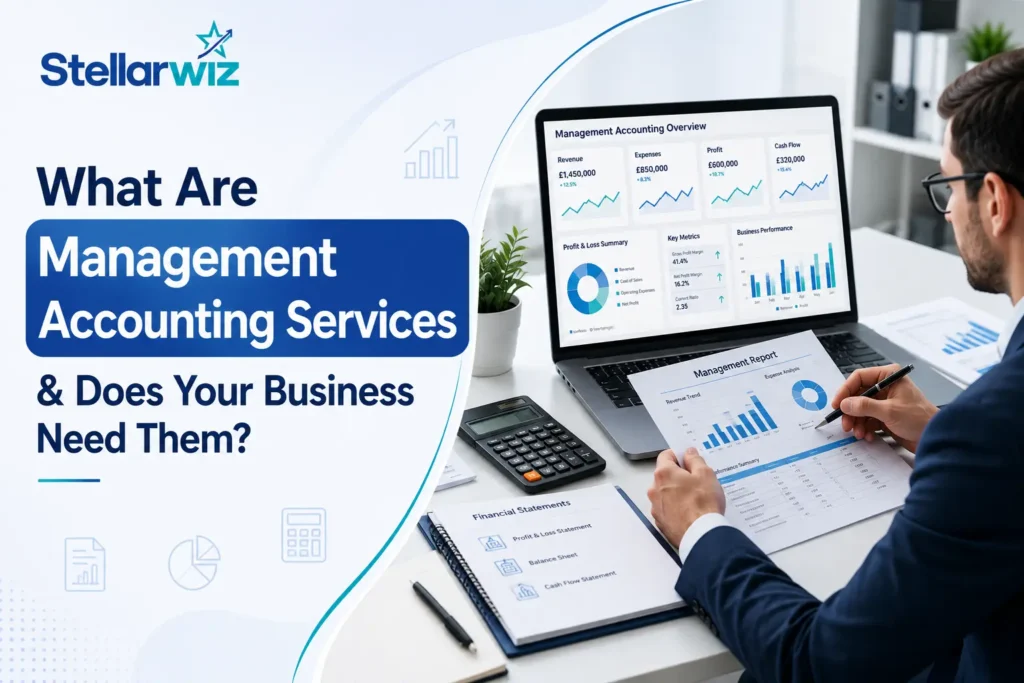
If you run a business in the UK, you’ve probably heard the term “management accounting” thrown about in the same breath as bookkeeping, tax returns, and year-end accounts. Management accounting, on the other hand, is a whole different animal. For many growing businesses, it’s the missing piece of the puzzle.
Management accounts show you what’s going on now and help you choose what to do next. Statutory accounts tell HMRC and Companies House what happened last year. In this guide, we’ll break down exactly what management accounting services UK are, how they differ from financial accounting, and why more UK businesses are turning to an outsourced accounting firm to get this vital insight without the overhead of hiring in-house.
Key Takeaways
- Statutory accounts only look backward, but management accounting looks ahead and gives you real-time information about cash flow, costs, and performance.
- 82% of small businesses in the UK have had cash flow problems, so it’s important to report and make predictions often.
- Outsourced management accounting services give businesses of any size access to expert support.
- It’s not just for big companies; startups, small businesses, and businesses that are growing can all benefit from being able to see their finances more clearly.
What are Management Accounting Services?
Management accounting services for businesses involve the preparation of detailed financial reports, forecasts, and analysis designed to help business owners and directors make informed decisions. Unlike statutory financial accounts, which are prepared annually and follow strict regulatory formats, management accounts are typically produced monthly or quarterly and are tailored entirely to what the business actually needs to know.
Typical management accounting services for growing businesses include:
- Monthly or quarterly management accounts: profit and loss, balance sheet, and cash flow statements
- Budgeting and forecasting: setting targets and projecting future performance
- Variance analysis: comparing actual performance against budget
- Cash flow management: tracking money in and out to avoid nasty surprises
- KPI reporting and financial dashboards: visual, easy-to-digest performance data
- Cost management and profitability analysis: understanding which products, services, or clients are actually making you money
- Business performance reporting: pulling everything together into a clear, actionable picture
This is the financial information that every smart businessperson uses to make decisions, like whether to hire a new employee, release a new product, or see if they can afford to move into a bigger space.
Read More:- Top 10 Outsourced Accounting Companies in the UK (2026 Guide)
Management Accounting vs Financial Accounting
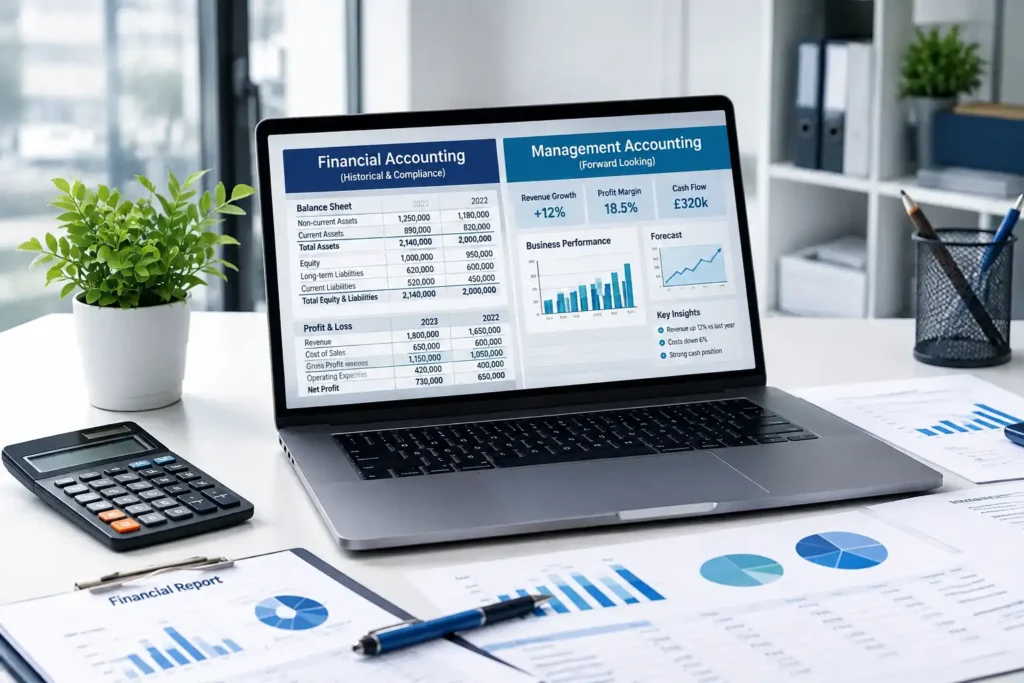
This is one of the most common questions we get asked, so it’s worth clearing up.
- Financial accounting is backward-looking and compliance-driven. It’s about producing statutory accounts, filing your tax return, and meeting the legal requirements set by HMRC and Companies House. These reports must follow strict formats (such as UK GAAP or IFRS) and are meant for people outside the company, like shareholders, tax authorities, and lenders.
- Management accounting, on the other hand, is forward-looking and internal. It doesn’t have to be in a certain format or be turned in by a certain date. Its only purpose is to help you and your leadership team run the business. Think of financial accounting as the rear-view mirror, and management accounting as the dashboard and sat nav.
Both are important, but only one of them helps you make decisions today.
Why Do Businesses Need Management Accounting Services?
An amazing number of small and medium-sized businesses in the UK run on “gut feel,” which means they check their bank balance and hope for the best. That approach might work when you’re small, but it becomes risky (and frankly, unsustainable) as the business grows. In fact, around 60% of UK small businesses fail within their first three years, and financial mismanagement is consistently cited as one of the leading causes.
Here’s why management accounting matters:
1. Better Decision Making
With accurate, up-to-date management information, you’re no longer guessing. You can see exactly which parts of the business are profitable, where costs are creeping up, and whether you can genuinely afford that new hire or piece of equipment.
2. Improved Cash Flow Management
Cash flow is the number one reason healthy, profitable businesses fail. In fact, as many as 82% of UK small businesses report having experienced cash flow difficulties at some point. You can find shortfalls before they become a crisis if you report and forecast your cash flow on a regular basis. This gives you time to act instead of react.
3. Stronger Budgeting and Forecasting
Setting a budget is one thing; tracking performance against it is another. Management accounting gives you the variance analysis needed to understand why you’re over or under budget, and what to do about it.
4. Increased Profitability
By breaking down costs and income into smaller pieces, management accounting can often find places where money is quietly leaving the business, like products that are too cheap, clients who don’t bring in enough money, or costs that aren’t necessary.
5. Investor and Lender Confidence
If you’re seeking investment or a loan, robust management information demonstrates that you’re on top of your numbers. It builds credibility and speeds up due diligence.
6. Supports Long-Term Strategic Planning
Whether you’re planning to scale, enter new markets, or eventually sell the business, sound management accounting gives you the data foundation to plan with confidence rather than assumption.
What Does a Management Accountant Do?

A management accountant takes raw financial data and turns it into meaningful, decision-ready information. Day-to-day, this typically involves:
- Preparing monthly or quarterly management accounts
- Building and maintaining budgets and rolling forecasts
- Analysing variances between actual and budgeted performance
- Producing KPI reports and financial dashboards for the leadership team
- Advising on cost control and pricing strategy
- Supporting cash flow planning and working capital management
- Presenting findings to directors in a clear, jargon-free way
A good management accountant is more than just good with numbers. They’re also a business partner who helps you use financial information in real life.
In-House vs Outsourced Management Accounting
Traditionally, only larger businesses could justify a full-time, in-house management accountant. But that’s changed. Today, outsourced management accounting services give businesses of every size access to senior-level financial expertise without the cost of a full-time salary, pension contributions, and overheads.
Here’s how the two compare:
| In-House | Outsourced | |
| Cost | Salary, NI, pension, benefits, training | Fixed monthly fee, scalable |
| Expertise | Limited to one person’s skillset | Access to a wider team of specialists |
| Flexibility | Fixed capacity | Scales up or down with the business |
| Technology | Business must invest in software | Provider typically brings cloud-based tools |
| Continuity | Risk if the person leaves or is off sick | Team-based cover, no single point of failure |
There is real evidence for this shift: companies that outsource their finance functions usually save 20–60% on costs compared to hiring an in-house team to do the same work. Outsourcing management accounting gives small, new, and growing businesses the best of both worlds: expert advice without the extra costs.
Who Needs Management Accounting Services?
Management accounting isn’t just for big corporations. There are 5.7 million small and medium-sized businesses (SMEs) in the UK, which is 99% of all businesses. Most of them don’t have their own finance department, so this kind of help is really useful for all kinds of businesses:
- Startups: building a solid financial foundation and understanding burn rate from day one
- Small businesses: gaining visibility that’s often missing when the founder is wearing every hat
- eCommerce businesses: tracking margins, inventory costs, and channel profitability
- Manufacturing companies: managing production costs, stock, and cash flow
- Service businesses: understanding utilisation, project profitability, and pricing
- Scaling businesses: needing robust reporting to support investment or expansion
You may have asked yourself, “Are we making money on this?” or “Can we afford to hire right now?” That is a sign that accounting could help with management.
How Outsourced Management Accounting Services Work

Modern outsourced management accounting services in the UK are typically delivered virtually, using cloud accounting software such as Xero, QuickBooks, or Sage. This means:
- Real-time access to your financial data, wherever you are
- Faster turnaround on monthly reports
- Seamless collaboration between your team and your outsourced finance partner
- No need for physical meetings or paper-based processes
- The ability to scale the service up or down as your business needs change
Along with management accounting, many providers also offer outsourced CFO support. This way, growing businesses can get strategic financial leadership on a part-time or intermittent basis without having to pay someone a six-figure salary.
How to Choose a Management Accounting Services Provider
If you’re considering outsourcing, here’s what to look for:
- Relevant experience: Ideally within your sector or business size
- Cloud accounting expertise: Comfortable working with Xero, QuickBooks, or Sage
- Clear, jargon-free reporting: You should understand your numbers, not need a translator
- Proactive communication: A provider who flags issues early, not just at month-end
- Scalability: A service that can grow alongside your business
- Transparent pricing: No hidden fees or surprise charges
A good outsourced accounting firm in the UKshould feel like an extension of your own team and care about your growth as much as they do about processing numbers.
Final Thoughts
Management accounting services help businesses in the UK see their finances clearly so they can make smart choices about everything from daily cash flow to long-term planning. Whether you’re a startup finding your feet or an established business looking to scale, having accurate, timely management information is no longer a nice-to-have; it’s essential.
Working with an outside accounting firm is a cheap way for companies that don’t need or have the resources to have their own finance team to get senior financial advice, detailed reports, and strategic support that is specific to their needs.
At Stellarwiz, we specialise in management accounting services in the UK, helping startups, SMEs, and growing businesses turn their numbers into a genuine competitive advantage. If you’re ready to move beyond guesswork and get real clarity on your business performance, our outsourced management accounting services could be exactly what you need.
Frequently Asked Questions
What are management accounting services?
Management accounting services include making detailed financial reports, budgets, forecasts, and performance analyses to help business owners and directors make smart decisions quickly. This is different from statutory accounting services, which are made to meet legal requirements.
Why are management accounting services important?
They give businesses real-time visibility into performance, profitability, and cash flow, enabling proactive decision-making rather than reactive firefighting.
What does a management accountant do?
A management accountant prepares management accounts, builds budgets and forecasts, analyses variances, monitors KPIs, and advises the leadership team on financial strategy and cost control.
How are management accounting and financial accounting different?
Financial accounting is backward-looking, compliance-focused, and produced for external parties like HMRC. Management accounting is forward-looking, flexible, and produced purely to support internal business decisions.
What reports are included in management accounting?
Typical reports include profit and loss statements, balance sheets, cash flow forecasts, budget vs actual comparisons, KPI dashboards, and profitability analysis.
Can small businesses benefit from management accounting services?
Absolutely. Small businesses often benefit the most, as management accounting provides clarity and structure that’s easy to lose when founders are juggling every aspect of the business themselves. Affordable, outsourced management accounting services make this accessible even without an in-house finance team.