“Accounting” isn’t one activity. It’s a collection of disciplines, each answering a different question: Is the business compliant? Is it profitable? Is it being run well? And can its numbers be trusted? Understanding the different types of accounting makes it much easier to work out which services your business actually needs, rather than paying for everything or, just as often, missing something important.
This guide walks through the main types of accounting, how they differ from bookkeeping, and how to work out which ones apply to your business.
Key Takeaways
- Accounting splits into several distinct disciplines, most commonly financial, management, tax, cost, forensic, payroll, and corporate accounting, each serving a different purpose.
- Bookkeeping and accounting are related but not the same. Bookkeeping records transactions; accounting interprets and reports on them.
- Financial accounting looks backwards for compliance and statutory reporting; management accounting looks forward to support day-to-day decisions.
- Most small and growing businesses need a mix of financial, tax, and some management accounting, rather than every type at once.
- As a business grows, the case for outsourcing some or all of this work usually gets stronger, since the required skill set grows too.
What Are the Different Types of Accounting?
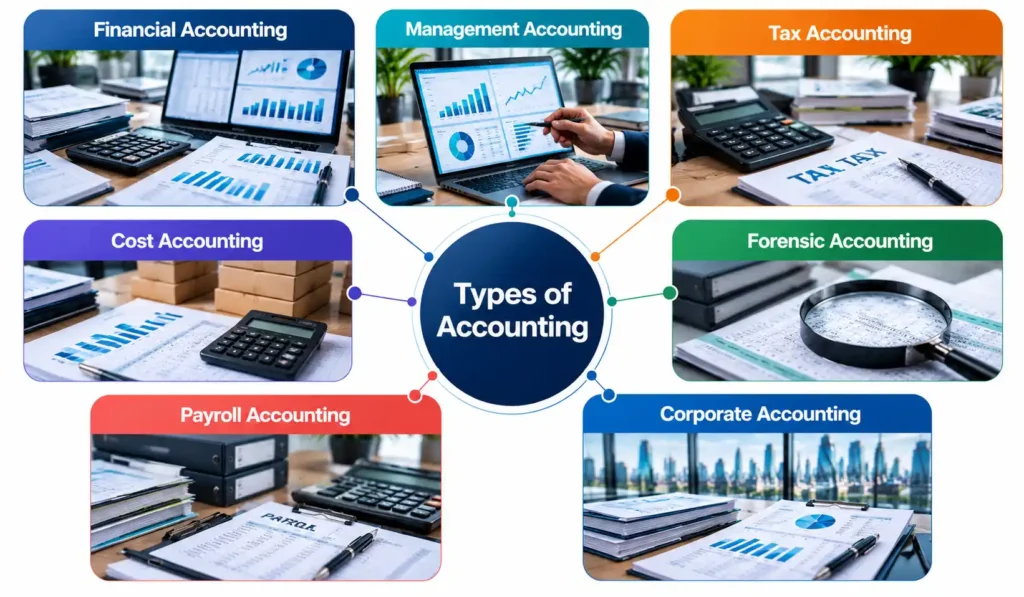
Broadly, accounting covers several distinct functions that overlap but serve different audiences: HMRC and regulators, business owners and managers, investors, and sometimes courts. Below are the types most UK business owners will encounter, and the kinds of accounting services for UK firms built around each one.
Financial Accounting
Financial accounting records and reports a business’s transactions in standard financial statements: the profit and loss statement, balance sheet, and cash flow statement. It’s backward-looking and rule-based, following UK accounting standards, and it’s what produces the statutory accounts filed with Companies House and used to calculate corporation tax.
Financial accounting is largely non-negotiable. Every limited company needs it to stay compliant, regardless of size.
Management Accounting
Management accounting is forward-looking and internal. Rather than producing statutory reports, it produces the information owners and managers actually use to run the business: budgets, forecasts, cash flow projections, and profitability by product, service, or client.
Where financial accounting asks “what happened,” management accounting asks “what should we do next.” It’s not a legal requirement, but it’s often what separates a business that’s merely compliant from one that’s actively managed.
Tax Accounting
Tax accounting focuses specifically on calculating and reporting tax liabilities: corporation tax, VAT, income tax, and payroll-related taxes, in line with HMRC rules. It includes tax planning to legally minimise liability, as well as preparing and filing the returns themselves.
With Making Tax Digital expanding to cover more businesses and individuals, tax accounting increasingly overlaps with the software and record-keeping systems a business uses day to day, not just the annual return.
Cost Accounting
Cost accounting looks at the cost of producing goods or delivering services, breaking down fixed and variable costs to understand true profitability per product, project, or job. Manufacturing, construction, and project-based businesses most commonly use it to know exactly what something costs to deliver before they price it.
Forensic Accounting
Forensic accounting investigates financial records, typically for legal purposes: fraud investigations, disputes between business partners, insurance claims, or divorce proceedings involving business assets. It combines accounting skill with investigative technique, and the findings are often prepared with litigation or arbitration in mind.
Most small businesses will never need forensic accounting, but it becomes relevant quickly if fraud is suspected or a dispute goes to court.
Payroll Accounting
Payroll accounting covers calculating and recording employee pay, tax deductions, National Insurance, pension contributions, and statutory payments. It sits close to both financial and tax accounting, since payroll figures feed directly into both, but it’s specialised enough that many businesses treat it as a distinct service. Practices with clinical or shift-based staff often look for healthcare bookkeeping services that understand rota-based pay and NHS pension contributions, rather than a generic payroll setup.
Corporate Accounting
Corporate accounting applies the same core principles as financial accounting but at the scale of larger or group company structures: consolidating accounts across subsidiaries, handling inter-company transactions, and meeting the more detailed reporting standards that apply to bigger organizations. Regulated sectors add another layer. A group of GP surgeries or dental practices, for example, often needs reporting built around sector rules, which is why many turn to dedicated healthcare accounting services rather than a generalist provider.
Financial Accounting vs Management Accounting

These two are the pair business owners most often confuse, so it’s worth being explicit about the difference.
Financial accounting is external, compliance-driven, and backward-looking. It follows a fixed format, is prepared periodically (usually annually), and is aimed at HMRC, Companies House, and anyone else with a statutory right to see it.
Management accounting is internal, flexible, and forward-looking. It can be produced monthly, weekly, or even daily, and its format is whatever’s most useful to the people running the business.
A useful way to think about it: financial accounts tell you whether last year was profitable. Management accounts help you work out whether this month, this client, or this decision will be.
Bookkeeping vs Accounting: What’s the Difference?
Bookkeeping is the process of recording financial transactions, invoices, payments, receipts, in an organised system. Accounting takes that data and turns it into something meaningful: financial statements, tax calculations, management reports, and analysis.
Put simply, bookkeeping answers “what transactions happened,” while accounting answers “what do these transactions mean.” Most businesses need both, and increasingly, accounting software and outsourced bookkeeping services handle these two functions together, since accurate bookkeeping is the foundation everything else depends on.
Which Type of Accounting Does Your Business Need?
Most businesses don’t need every type of accounting. A practical way to narrow it down:
- Every limited company needs financial accounting to stay compliant, plus tax accounting to handle corporation tax and VAT.
- Any business with employees needs payroll accounting, whether that’s handled in-house or by a provider.
- Growing or multi-service businesses benefit from management accounting services once decisions start getting harder to make from gut feel alone, typically once there’s more than a handful of clients, products, or cost centres to track.
- Manufacturing, construction, and project-based businesses usually need at least some cost accounting to price jobs accurately.
- Forensic accounting is only relevant if fraud, a dispute, or litigation is already on the table.
Sole traders and very small businesses often start with just bookkeeping and basic tax accounting, then add management accounting as the business grows and decisions become more complex.
Accounting Services for UK Small Businesses

For most small and growing businesses, the practical starting point is a combination of accurate bookkeeping, statutory financial accounting, and tax compliance, with more forward-looking support layered in once the business needs regular visibility into performance rather than just an annual set of accounts.
Accounting for small businesses doesn’t need to mean hiring a full in-house finance team. A mix of software, a part-time bookkeeper, and periodic accountant support covers most needs until the business reaches a size where a dedicated finance function starts to make sense.
When Should a Business Outsource Accounting?
Outsourcing tends to make sense at a few specific points:
- When accounting starts taking time away from running the business. If bookkeeping, payroll, or chasing invoices is eating into hours that should go toward clients or growth, it’s usually cheaper to outsource than to keep absorbing the cost personally.
- When the business needs skills it doesn’t have in-house. Management accounting, tax planning, and multi-entity reporting all require specific expertise that’s expensive to hire for directly, especially for a business that only needs it part-time.
- When compliance risk starts to matter more. As turnover, staff numbers, or VAT complexity grow, the cost of getting something wrong grows with it, and professional support reduces that risk.
- When the business needs better financial visibility to grow. Owners trying to raise finance, plan expansion, or make pricing decisions usually need management accounting support well before they can justify a full-time finance hire.
Outsourced accounting services for UK businesses let them access the right mix of bookkeeping, financial, tax, and management accounting without the cost of a full internal team, and scale that support up or down as the business changes.
How Stellarwiz Supports UK Businesses
Understanding the different types of accounting is the first step. Getting the right mix of support in place, without overpaying for services you don’t need yet, is the harder part.
Stellarwiz provides outsourced accounting services UK businesses use to cover bookkeeping, financial reporting, tax compliance, and management accounting under one team, scaled to the size and stage of the business rather than a fixed package, including support for regulated sectors with their own reporting requirements.
Whether a business needs a single service or a full outsourced finance function, matching the right type of accounting support to where the business actually is, rather than a generic package, tends to make the biggest difference to both cost and usefulness.
Also Read: Top 10 outsourced accounting companies in the uk
Final Thoughts
The different types of accounting aren’t competing options. They’re different tools for different jobs: financial accounting for compliance, management accounting for decisions, tax accounting for HMRC, cost accounting for pricing, and forensic accounting for disputes. Most businesses need only a handful at any one time, and the mix usually shifts as the business grows. The clearest way to decide what you need now is to look at what’s currently missing: compliance you’re unsure about, decisions you’re making without good data, or costs you can’t fully explain, and start there.
Frequently Asked Questions
What are the different types of accounting?
The main types are financial accounting, management accounting, tax accounting, cost accounting, forensic accounting, payroll accounting, and corporate accounting. Each serves a different purpose, from statutory compliance to internal decision-making to investigating financial disputes.
How can professional accounting services help a business grow?
Professional accounting support gives owners accurate, timely financial information to base decisions on, keeps the business compliant as it scales, and frees up time that would otherwise go to bookkeeping and admin so owners can focus on running and growing the business.
What is the difference between financial and management accounting?
Financial accounting is backwards-looking, compliance-driven, and follows a fixed statutory format aimed at HMRC and Companies House. Management accounting is forward-looking, flexible, and produced for internal use to support day-to-day business decisions.
Is bookkeeping the same as accounting?
No. Bookkeeping records financial transactions. Accounting takes that recorded data and turns it into financial statements, tax calculations, and management reports, interpreting the numbers rather than just logging them.
What does a tax accountant do?
A tax accountant calculates and files a business’s tax obligations, including corporation tax, VAT, and payroll taxes, while also identifying legal ways to plan and reduce tax liability in line with current HMRC rules.