Accurate bookkeeping is the backbone of every successful business. Whether you are a startup, a growing company, or an established enterprise, maintaining organised financial records helps you make informed decisions, manage cash flow, and stay compliant with tax regulations. Common bookkeeping mistakes, even small ones, can lead to costly consequences: inaccurate financial reporting, missed HMRC deadlines, cash flow shortfalls, and unnecessary penalties that eat into profit.
For UK businesses and accounting firms alike, the cost of poor bookkeeping rarely shows up straight away. It builds quietly through unreconciled accounts, misclassified expenses, and records that only get attention when a VAT return or Companies House filing is due. The good news is that most bookkeeping errors are preventable once you know where they typically start.
In this guide, we cover the most common bookkeeping mistakes, explain their impact on your business, and share practical bookkeeping tips to help you maintain accurate financial records, strengthen your bookkeeping process, and support long-term compliance under Making Tax Digital and HMRC reporting rules.
Key Takeaways
- Accurate bookkeeping supports better decision-making, cash flow management, and tax compliance.
- Mixing personal and business finances is one of the most common bookkeeping mistakes and should be avoided.
- Regular bank reconciliation helps detect missing, duplicate, or incorrect transactions.
- Proper invoice management and expense tracking improve cash flow and financial reporting accuracy.
- Maintaining organised payroll records and updating books regularly reduces compliance risk.
- Waiting until tax season increases the likelihood of bookkeeping errors and missed deductions.
- Following consistent bookkeeping best practices and a monthly bookkeeping checklist helps keep financial records accurate and audit ready.
Why Good Bookkeeping Matters
Bookkeeping is more than recording income and expenses. It provides a clear picture of your business’s financial health, helping you monitor profitability, prepare financial statements, manage tax obligations, and plan for future growth.
Following bookkeeping best practices enables businesses to:
- Monitor cash flow effectively.
- Make informed financial decisions.
- Prepare accurate tax returns.
- Maintain compliance with financial regulations, including VAT and Corporation Tax obligations.
- Identify opportunities to reduce costs and improve profitability.
In our experience supporting UK businesses, the companies that treat bookkeeping as a weekly discipline rather than an annual scramble are the ones that spot cash flow problems early enough to act on them. If your business is growing, you can save time and reduce risk by investing in reliable bookkeeping and VAT return support rather than letting records fall behind.
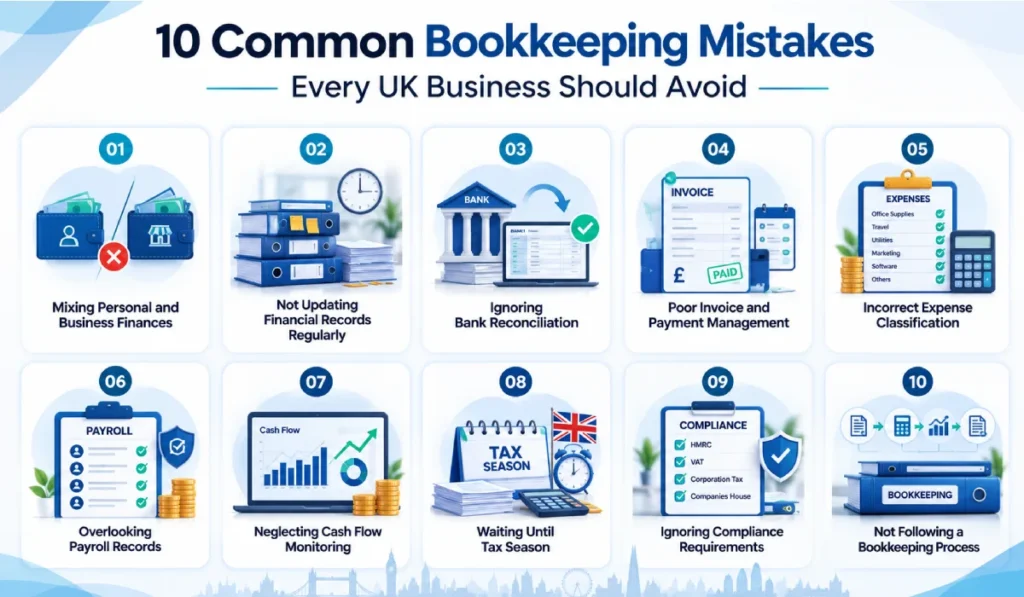
Suggested visual: a simple infographic summarizing the ten mistakes, placed here as a scannable overview before the detailed breakdown below.
1. Mixing Personal and Business Finances
One of the most common bookkeeping mistakes small businesses make is using the same bank account or credit card for personal and business expenses. Our bookkeeping specialists frequently see this in newly formed limited companies, where a director’s personal card is used for a business purchase and never formally recorded.
This habit makes expense tracking difficult, complicates VAT and Corporation Tax reporting, and creates confusion when preparing year-end financial statements. It also increases the time and cost involved if HMRC ever asks for supporting evidence.
How to avoid it:
- Open a dedicated business bank account.
- Use a separate business credit card for all company spending.
- Record every business transaction accurately and promptly.
2. Not Updating Financial Records Regularly
If you do not update your books until the end of the month, or worse, until tax season, transactions get missed or reported incorrectly. Poor financial record-keeping makes it difficult to understand your current financial position and increases the risk of overlooked expenses or unpaid invoices.
How to avoid it:
- Update bookkeeping weekly, or ideally in real time.
- Use cloud-based accounting software with live bank feeds.
- Schedule a recurring bookkeeping review, even if it is brief.
Expert Tip Block out 30 minutes at the same point each week to review new transactions and flag anything unclear. A small, consistent habit prevents the large end-of-month backlog that causes most bookkeeping errors.
3. Ignoring Bank Reconciliation
Failing to perform regular bank reconciliation is one of the most overlooked bookkeeping errors. Without comparing your accounting records against bank statements, duplicate transactions, missing payments, or fraudulent activity can go unnoticed for months.
How to avoid it:
- Reconcile accounts every month at a minimum.
- Investigate discrepancies immediately rather than deferring them.
- Keep supporting documentation for every transaction.
4. Poor Invoice and Payment Management
Late invoices and unpaid bills can quickly affect cash flow. Weak invoice management, along with poor monitoring of accounts receivable and accounts payable, often leads to delayed payments and strained supplier relationships.
Late payment is not a minor inconvenience for UK small businesses. Research from the Federation of Small Businesses links cash flow problems caused by late payment to around 50,000 small business closures in the UK each year. Clear, consistent invoicing and credit control are among the most direct ways bookkeeping protects a business from that risk.
How to avoid it:
- Send invoices promptly and consistently.
- Track payment due dates against a credit control schedule.
- Follow up on overdue invoices without delay.
- Automate reminders where your software allows it.
Structured accounts payable and receivable support can take this off a business owner’s plate entirely, particularly once invoice volume grows beyond what a spreadsheet can track reliably.
5. Incorrect Expense Classification
Using the wrong chart of accounts or categorising expenses incorrectly creates inaccurate financial reports and causes complications during tax preparation. This is one of the most common bookkeeping errors, and fixing it starts with a clear, consistent expense categorisation process.
How to avoid it:
- Create a structured chart of accounts from the outset.
- Review expense categories regularly, not only at year end.
- Consult a bookkeeping professional when a transaction is unclear.
Expert Tip If you are ever unsure whether an expense is allowable or how it should be categorised, flag it rather than guess. A short note now saves hours of reconstruction work at year end.
6. Overlooking Payroll Records
Incomplete or inaccurate payroll records can result in employee payment issues, compliance problems, and tax reporting errors. Payroll mistakes are particularly risky because they can lead to financial penalties and employee dissatisfaction at the same time.
How to avoid it:
- Maintain accurate, up-to-date payroll records.
- Review payroll figures before each processing run.
- Keep employee tax and pension information current.
Many businesses we work with underestimate how closely payroll accuracy and bookkeeping accuracy are linked. Payroll costs flow directly into your management accounts, so an error in one distorts the other. Dedicated payroll services that handle PAYE, RTI submissions, and Auto-Enrolment reduce this risk considerably.
7. Neglecting Cash Flow Monitoring
Many businesses focus only on profit while overlooking actual cash movement. Bookkeeping mistakes that affect cash flow visibility can leave a business struggling to pay suppliers despite appearing profitable on paper. Regular cash flow forecasting helps identify potential shortages before they become serious problems.
How to avoid it:
- Review cash flow reports regularly, not only at month end.
- Forecast future income and expenses on a rolling basis.
- Monitor outstanding customer payments closely.
Clear management accounts give business owners the monthly visibility needed to catch a cash flow problem while there is still time to act on it, rather than discovering it at year end.
Suggested visual: a simple cash flow illustration showing profit versus available cash over a typical month, placed here to reinforce the point.
8. Waiting Until Tax Season
One of the biggest bookkeeping mistakes every startup should avoid is postponing bookkeeping until tax deadlines approach. This often results in rushed reporting, missing receipts, and avoidable errors. It also increases the likelihood of bookkeeping errors during tax season, which can delay filings or require costly corrections.
How to avoid it:
- Keep records updated throughout the year.
- Store receipts digitally as they arrive.
- Schedule quarterly financial reviews ahead of filing deadlines.
This matters more than ever under Making Tax Digital. HMRC estimates that more than 860,000 self-employed individuals and landlords with income above £50,000 will need to move to Making Tax Digital for Income Tax from April 2026, which requires digital records and quarterly submissions rather than a single annual return.
9. Ignoring Compliance Requirements
Every business has legal responsibilities for maintaining financial records and meeting reporting obligations, including those set by HMRC and Companies House. Poor bookkeeping compliance can result in HMRC enquiries, penalties, or unnecessary stress during tax season.
HMRC can charge a penalty of up to 30 percent of the unpaid tax where an error is judged careless, though this can be reduced, in some cases to zero, where a business discloses the mistake voluntarily before HMRC opens an enquiry. Keeping accurate financial records throughout the year is one of the simplest ways to demonstrate reasonable care and reduce that risk.
How to avoid it:
- Understand your reporting obligations under VAT, Corporation Tax, and Companies House rules.
- Retain financial records for the required statutory period.
- Stay informed about changing tax regulations and MTD deadlines.
Expert Tip If you spot an error after a return has been filed, correct it and tell HMRC before they find it themselves. An unprompted disclosure is treated far more favourably than one HMRC uncovers during a check.
10. Not Following a Bookkeeping Process
Without a consistent bookkeeping process, errors become more frequent as a business grows. A structured routine ensures transactions are recorded accurately, reconciliations are completed on schedule, and reports stay up to date.
How to avoid it:
- Build a monthly bookkeeping checklist and follow it consistently.
- Assign clear ownership for each bookkeeping task.
- Review the process periodically as transaction volume grows.
For businesses looking to formalize this without adding headcount, Stellarwiz provides professional bookkeeping support designed to improve accuracy, compliance, and financial visibility.
Suggested visual: a bookkeeping workflow diagram showing the monthly cycle from transaction recording through reconciliation, reporting, and review.
Bookkeeping Mistakes at a Glance
| Bookkeeping Mistake | Business Impact | Best Solution |
| Mixing personal and business finances | Confused records, harder tax reporting | Separate business bank account and card |
| Not updating records regularly | Missed transactions, unclear cash position | Weekly or real-time bookkeeping updates |
| Ignoring bank reconciliation | Undetected errors, duplicate payments, fraud risk | Monthly reconciliation with prompt review |
| Poor invoice and payment management | Cash flow strain, late payments | Structured invoicing and credit control |
| Incorrect expense classification | Inaccurate reports, tax preparation issues | Structured chart of accounts, regular review |
| Overlooking payroll records | Payment errors, compliance risk | Accurate, reviewed payroll processing |
| Neglecting cash flow monitoring | Cash shortages despite reported profit | Rolling cash flow forecasting |
| Waiting until tax season | Rushed filings, missed deductions | Year-round record keeping |
| Ignoring compliance requirements | HMRC penalties, audit risk | Understand obligations, retain records |
| No consistent bookkeeping process | Rising error rate as the business grows | Monthly checklist with clear ownership |
Best Practices to Improve Your Bookkeeping
You can keep your books accurate without overcomplicating the process. These bookkeeping tips help improve efficiency and reduce errors:
- Record transactions consistently, ideally weekly.
- Reconcile bank accounts monthly.
- Organise receipts and invoices digitally.
- Review financial statements regularly, not only at year end.
- Monitor accounts payable and receivable closely.
- Track expenses accurately against a structured chart of accounts.
- Maintain complete, reviewed payroll records.
- Follow a monthly bookkeeping checklist.
Businesses that put these habits in place, with support from Stellarwiz’s bookkeeping and VAT team, are better equipped to manage finances and make informed decisions as they grow. If bookkeeping is becoming time-consuming or your records are falling behind, it may be time to explore outsourced bookkeeping support built around UK compliance requirements.
Stay Compliant Without the Admin Burden
Bookkeeping mistakes are rarely about a lack of effort. They usually come down to time, process, and the absence of a system that scales with the business. Stellarwiz combines UK-qualified oversight with day-to-day bookkeeping delivery, so records stay accurate, VAT and MTD obligations stay on track, and business owners get their time back.
Talk to our team about outsourced bookkeeping support built around your existing software and reporting needs.
Frequently Asked Questions
1. What are the most common bookkeeping mistakes businesses make?
Common bookkeeping mistakes include mixing personal and business finances, failing to reconcile bank accounts, delaying record updates, misclassifying expenses, poor invoice management, and neglecting payroll records. Most of these stem from inconsistent processes rather than a single large error.
2. Why is accurate bookkeeping important for small businesses?
Accurate bookkeeping helps businesses monitor financial performance, maintain organised financial records, improve cash flow visibility, prepare reliable financial statements, and remain compliant with VAT and Corporation Tax obligations throughout the year.
3. How do bookkeeping mistakes affect cash flow?
Bookkeeping errors can lead to unpaid invoices, overlooked expenses, inaccurate cash flow forecasting, and poor financial decisions, all of which can create cash shortages even when a business appears profitable on paper.
4. Can bookkeeping errors result in tax penalties?
Yes. Incorrect financial records, missing documentation, inaccurate expense reporting, or late filings can lead to HMRC penalties, interest charges, or closer scrutiny of future returns, particularly where an error is judged careless rather than an innocent mistake.
5. How often should financial records be updated?
Ideally, records should be updated weekly or in real time using cloud accounting software. Regular bookkeeping makes reporting more accurate, simplifies VAT and Corporation Tax preparation, and helps identify financial issues before they grow into larger problems.
6. What bookkeeping records must UK businesses keep?
UK businesses are generally required to keep records of income, expenses, VAT documentation, payroll information, and supporting evidence such as receipts and invoices for the statutory retention period set by HMRC and Companies House.
Final Thoughts
Most bookkeeping mistakes are avoidable once a business has a consistent process, whether that means separating personal and business finances, reconciling accounts monthly, or keeping payroll and expense records current throughout the year. Left unaddressed, these small gaps compound into inaccurate reporting, missed HMRC deadlines, and cash flow pressure that is far harder to fix after the fact.
Proactive, well-organised bookkeeping is not just a compliance requirement. It is one of the clearest ways a UK business protects its cash flow and gives itself accurate numbers to make decisions on. If your current bookkeeping process is falling behind, Stellarwiz’s outsourced bookkeeping and VAT support can bring it back on track without adding to your headcount.